
Industrial Air Mover Vacuum
High-volume air mover vacuum service across the Southeast, pneumatic conveyance for sand, dust, catalyst, fly ash, powders, and dry bulk material.
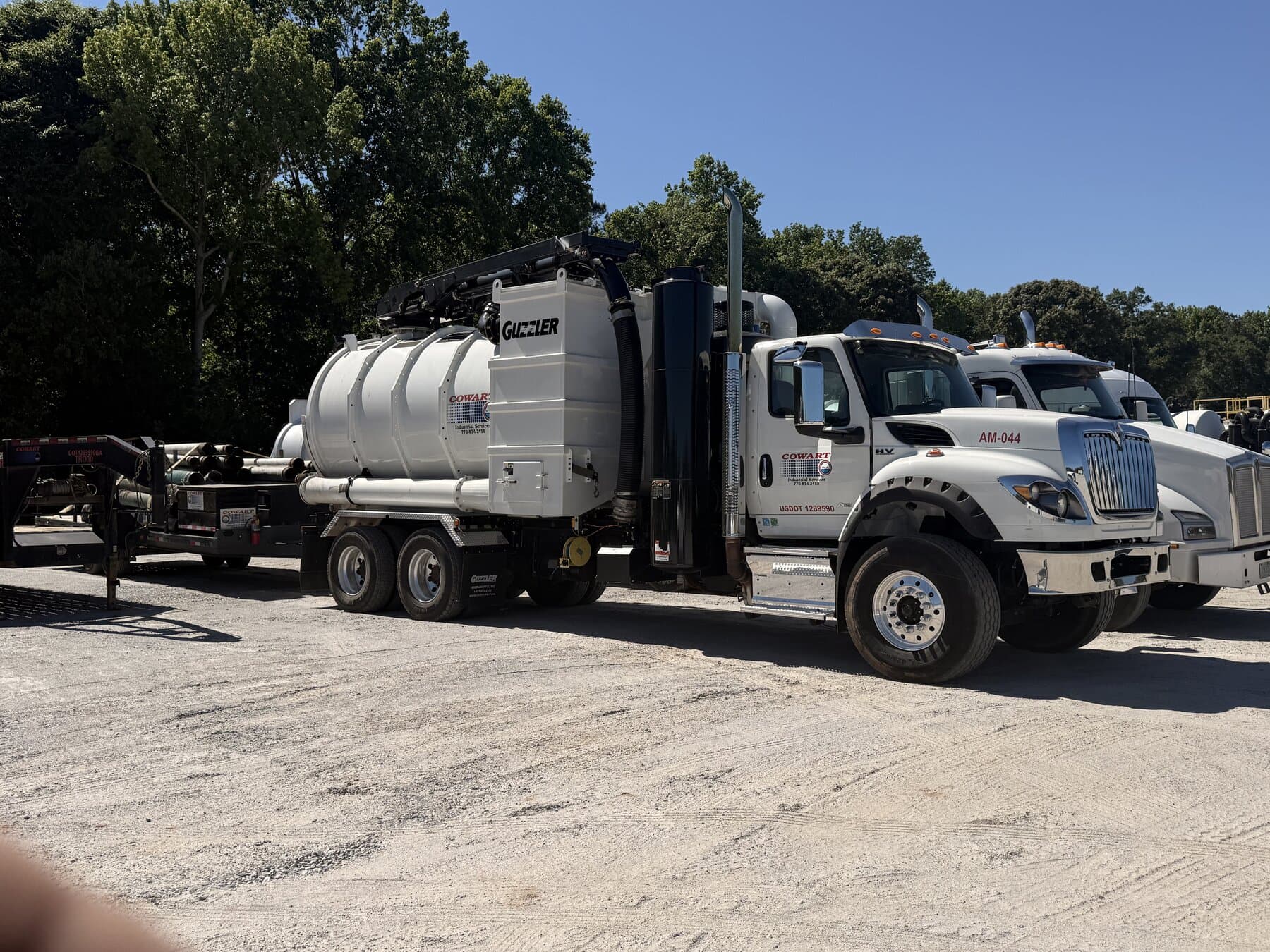
Cowart Industrial's high-volume air mover vacuum service uses pneumatic conveyance to remove dry solids and bulk material from industrial facilities. Air movers (sometimes called industrial dry-vac trucks or pneumatic vacuum trucks) are the right tool for sand, dust, dewatered cake, fly ash, catalyst, powders, grain, refractory, and any solid waste stream that handles dry. Unlike water-based vacuum trucks, air movers don't introduce moisture into the load, important for material that has to stay dry for downstream handling, off-spec product that may be reused, or pyrophoric and water-reactive deposits where adding water creates a hazard.
Air mover service runs at high CFM, which means cleanouts that would take days with manual labor finish in hours. Typical jobs include silo and bin cleanouts, baghouse and dust collector emptying, catalyst removal from reactors, spilled-product recovery, fly-ash recovery from boilers and ESPs, refractory removal, and confined-space material removal for vessel entry prep. The work pairs naturally with sealed vacuum boxes and roll-off containers for haul-off, the air mover does the recovery, the box catches the material, and a tractor moves it to disposal under one DOT number.
Air mover operations require trained operators. The pressure differentials, pneumatic conveyance velocities, and dust loadings carry their own safety profile, especially in confined spaces and around combustible-dust environments. Cowart's crews are HAZWOPER-40 and OSHA-30 certified, hold confined-space credentials, and are trained on combustible-dust protocols (grounding, bonding, deflagration prevention) where the material warrants it. The crew that arrives on a fly-ash cleanout isn't a generic vacuum-truck crew, it's a crew trained for that material.
Air mover vs. liquid vacuum, when to use which
Air movers and liquid vacuum trucks look superficially similar but are engineered for different material. A liquid vacuum truck runs a positive-displacement blower against a sealed tank to pull free-flowing liquids up a hose. An air mover runs a much larger blower at much higher airflow (thousands of CFM) to convey dry bulk material through an airstream into a cyclone separator and discharge it under control. Pressing a liquid truck into dry-bulk service plugs the hose and damages the blower; pressing a dry truck into liquid service damages the blower from a different direction.
Air movers are the right tool when the material is dry and free-flowing or can be agitated free, when adding water would create a problem (reactive deposits, off-spec product reuse, downstream processing constraints), and when production rate matters more than absolute fine-particle capture. They are not the right tool for sludge, slurries, or anything that needs to be sealed against moisture migration, vacuum boxes or liquid tankers are the right answer there.
Common applications
Silo and bin cleanouts are the textbook air mover job, empty a 50-foot silo without sending people inside, which is the safest possible answer for a confined-space inspection or product changeover. Baghouse and dust collector emptying is similar: the air mover pulls the accumulated dust into the truck through a hose attached to the hopper drop, no manual scooping, no exposure to whatever the baghouse was capturing.
Fly-ash recovery from coal and biomass boilers, ESP hopper cleanout, and bottom-ash recovery are heavy-duty air mover applications. Catalyst removal from reactors during turnarounds, both spent catalyst recovery and fresh catalyst loading, is another standard scope. Refractory removal from boilers and furnaces, especially the broken and friable material that demolition crews leave behind, is recovered by air mover before the next refractory crew comes in.
Spill response for dry material, bulk powder spills, off-loaded product accidents, dust accumulation in equipment rooms, runs on air movers as well. The pneumatic recovery preserves the material when it's reusable and contains it when it's not.
Industries we serve
Where we work
- Atlanta
- Augusta
- Columbus
- Macon
- Savannah
- Carrollton
- LaGrange
- Newnan
- Rome
- Birmingham
- Mobile
- Montgomery
- Huntsville
- Tuscaloosa
- Anniston
- Knoxville
- Chattanooga
- Nashville
- Memphis
- Columbia
- Charleston
- Greenville
- Spartanburg
- Charlotte
- Raleigh
- Greensboro
- Wilmington
- Jacksonville
- Tampa
- Pensacola
- Panama City
- Jackson
- Meridian
- Pascagoula
- Gulfport
- Louisville
- Lexington
- Owensboro
- Paducah
Common questions
Quick answers on scope, method, safety, and turnaround. Don’t see your question? Ask us directly.
Q-01What is an air mover vacuum truck?
An air mover (or industrial dry-vac truck) is a high-airflow pneumatic vacuum truck designed to recover dry bulk material, sand, dust, catalyst, fly ash, powders, refractory, and similar solids. It uses a large blower and a cyclone separator to convey material through an airstream into a sealed compartment, then discharges it under control to a vacuum box or other receiver.
Q-02What can air mover trucks pick up?
Sand, dust, dewatered cake, fly ash, catalyst pellets, refractory debris, dry powders (food, chemical, mineral), grain, plastic pellets, cement, lime, sawdust, and most dry bulk industrial material. The material has to be dry, slurries, sludge, and wet material aren't recovered cleanly by air movers and should go to a liquid vacuum truck or vacuum box instead.
Q-03Can air movers work in combustible-dust environments?
Yes, with the right protocols. Combustible-dust work requires grounding and bonding of all conductive equipment, dust-tight connections, deflagration prevention measures on the truck, and operator training specific to the material's hazard profile. Our crews are trained for combustible-dust protocols, and we can produce the documentation your facility safety program requires before the work starts.
Q-04What about silo cleanouts, do you do those?
Yes, silo and bin cleanout is one of the most common air mover applications. We recover the residual material through the discharge hopper or a top access without sending people into the silo. That keeps the cleanout out of confined-space classification (or, if entry is still required, dramatically reduces the time inside) and minimizes exposure to whatever the silo was holding.
Q-05Can you remove catalyst from reactors?
Yes. Catalyst removal and changeout is a standard turnaround scope. We recover spent catalyst by air mover, transport it under appropriate manifests, and can load fresh catalyst into the reactor for the same outage. Inert-atmosphere catalyst work (where the catalyst is pyrophoric or requires nitrogen blanket) requires additional preparation; we work that scope with the reactor's process engineer to set the procedure.
Q-06What's the difference between an air mover and a regular vacuum truck?
A regular (liquid) vacuum truck uses a positive-displacement blower to lift free-flowing liquids into a sealed tank. An air mover uses a much larger blower at much higher airflow to convey dry bulk material through an airstream into a cyclone separator. The blower sizes, hose diameters, separator designs, and operator training are different, the two trucks are not interchangeable, and most industrial cleanout jobs need one or the other (or both).
Q-07What states do you cover with air mover service?
Georgia, Alabama, Tennessee, South Carolina, North Carolina, Florida, Mississippi, and Kentucky, the full 8-state Southeastern footprint, dispatched from Carrollton, GA. Air mover units are scheduled like the rest of our vacuum fleet, with 24-hour emergency dispatch for spill response and unplanned cleanouts.