Industrial Hydroblasting
Industrial hydroblasting for scale, coatings, and surface prep. Water only, no chemicals or grit. Crews across Georgia and the Southeast, 24-hour dispatch.
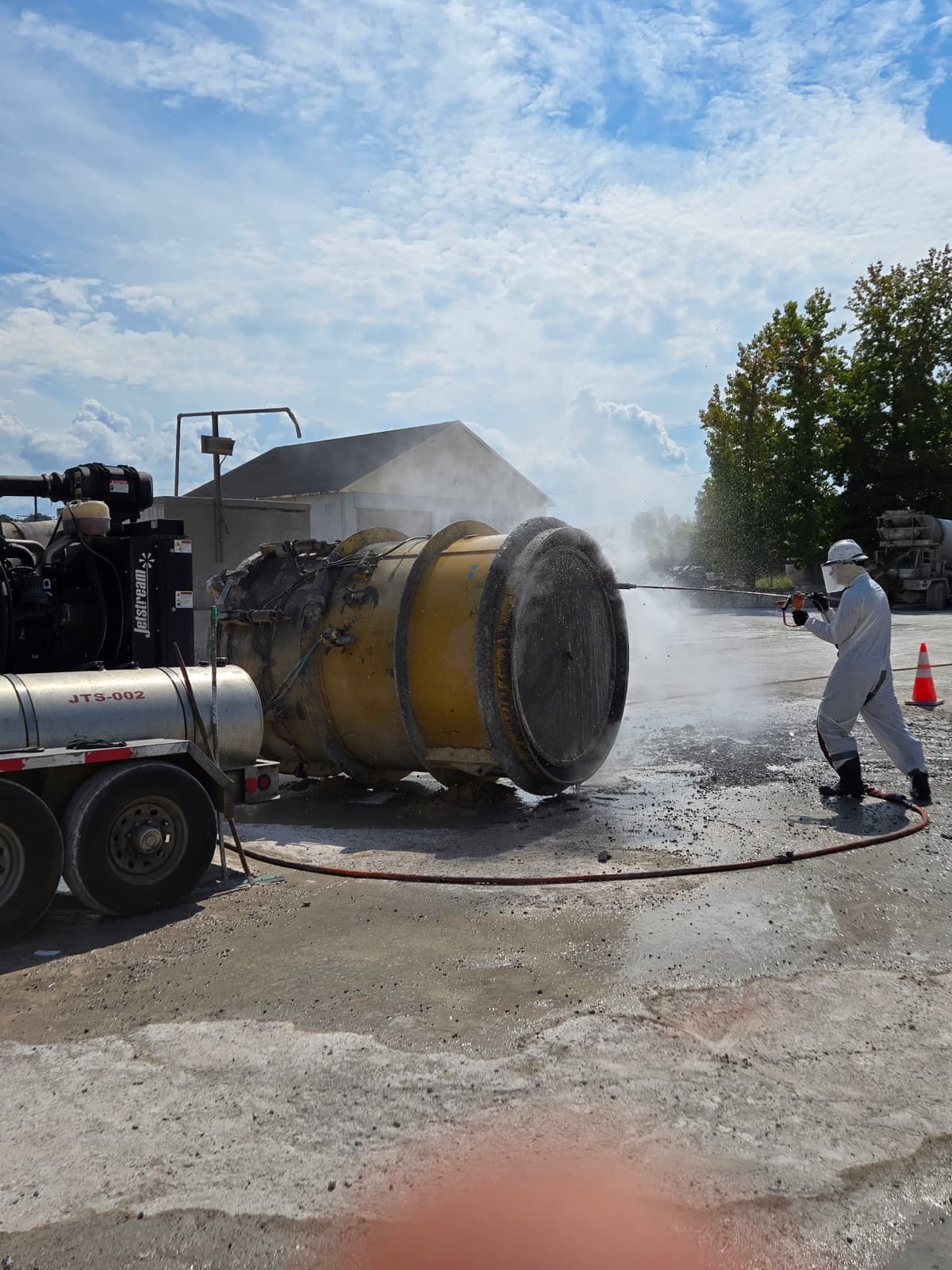
Industrial hydroblasting (also written hydro blasting or water blasting) uses ultra-high-pressure water, UHP in industry shorthand, to remove scale, rust, hardened deposits, and failed coatings from industrial surfaces. Cowart operates hydroblasting equipment from 10,000 PSI for general cleaning up to 40,000 PSI for the hardest deposits and most demanding surface-preparation work. Because the process uses only water, it produces no chemical residue and leaves no abrasive media behind, the substrate comes out clean and the waste stream is just spent water and the material you removed.
Hydroblasting is the right method when mechanical cleaning is too slow, sandblasting is too damaging or too dusty, and chemical cleaning isn't permitted or worth the rinse cycle. Common targets include heat-exchanger tube bundles, fired-boiler tube walls, fin-fan and condenser tube banks, piping and process lines, storage tanks, pressure vessels, reactors, and concrete or steel structures being prepped for new coatings. The pressure, flow rate, and nozzle are matched to the material, the same rig that strips epoxy off concrete can be dialed back to clean a stainless heat exchanger without polishing the metal.
Cowart Industrial runs hydroblasting projects from single-shift maintenance work up through multi-week plant turnarounds. Operators are HAZWOPER-40 and OSHA-30 certified and carry confined-space credentials, most industrial hydroblasting jobs touch at least one of those, and we coordinate with site safety, lockout/tagout, and isolation procedures before the trigger is pulled. Spent water and dislodged material are collected on site, transported under our own DOT number, and disposed through our Carrollton, Georgia treatment plant. The job ends in one place, not three.
Cowart Industrial provides industrial hydroblasting across Georgia and the Southeast, with crews dispatched from our base in Carrollton, west of Atlanta. The eight-state service area covers Georgia, Alabama, Tennessee, South Carolina, North Carolina, Florida, Mississippi, and Kentucky. Scheduled hydroblasting is typically quoted within one business day and on site the same week; for plant breakdowns and turnaround support, 24-hour emergency dispatch mobilizes same-day across the Atlanta metro, west Georgia, and east Alabama, and within the week across the rest of the region. Because one company owns the trucks, the treatment plant, and the disposal paperwork, a single call covers the cleaning, the spent-water recovery, and the non-hazardous disposal under one DOT number. To reach dispatch for industrial hydroblasting anywhere in the Southeast, call 770.834.2158.
How industrial hydroblasting works
Hydroblasting turns water into a cutting tool. A high-pressure pump, typically a positive-displacement plunger pump driven by a diesel engine, pressurizes water to between 10,000 and 40,000 PSI and pushes it through a small-diameter, abrasion-resistant hose to a hand-held or automated tool. At the nozzle, the pressure is converted to velocity: a 40,000 PSI jet leaves the orifice at roughly Mach 2, fast enough to fracture hardened scale, sever coatings from steel, and erode concrete laitance, all without touching the substrate with anything but water.
The choice of pressure depends on the substrate and the deposit. 10,000 to 15,000 PSI is the working range for general industrial cleaning, soft scale, and biological fouling. 20,000 to 25,000 PSI is where coating removal and most heat-exchanger work lives, it cuts paint and epoxy without distorting metal. 35,000 to 40,000 PSI is reserved for hard mineral scale, concrete preparation, and the hydro prep surface preparation system used for coatings that have to meet SSPC SP-WJ standards before recoating. Higher pressure isn't always better: over-pressuring a soft substrate polishes or pits it. Method selection is part of the job, not an afterthought.
Tool choice matters as much as pressure. Hand-held lances are still standard for general cleaning, but automated tools, rotating tube lances for heat exchangers, semi-automated tank cleaners, and robotic crawlers, keep operators out of the kill zone and produce more consistent results. Cowart operates both, and the right one for the job is the one specified in the cleaning plan, not the one already on the truck.
Hydroblasting vs. sandblasting, dry ice, and chemical cleaning
Hydroblasting is often the preferred method because it removes the deposit without adding to the waste stream. Sandblasting buries the contamination under spent abrasive that has to be disposed as one combined waste, a disposal cost multiplier on contaminated equipment. Dry-ice blasting is clean but slow and expensive at industrial scale, and it can't touch hardened mineral deposits. Chemical cleaning works for the inside of equipment when access is limited, but it adds a rinse cycle, a neutralization step, and a regulated waste stream of its own.
Hydroblasting's limits are honest ones: it can't dissolve scale chemically locked to a substrate (gypsum, some sulfate deposits), and it doesn't work well on water-reactive process residues, those need a chemistry pass first, then a hydro rinse. For most heat-exchanger, boiler, tank, and surface-prep work, hydroblasting is faster, cheaper to dispose of, and easier to permit than the alternatives.
Industries we serve
Where we work
- Atlanta
- Augusta
- Columbus
- Macon
- Savannah
- Carrollton
- LaGrange
- Newnan
- Rome
- Birmingham
- Mobile
- Montgomery
- Huntsville
- Tuscaloosa
- Anniston
- Knoxville
- Chattanooga
- Nashville
- Memphis
- Columbia
- Charleston
- Greenville
- Spartanburg
- Charlotte
- Raleigh
- Greensboro
- Wilmington
- Jacksonville
- Tampa
- Pensacola
- Panama City
- Jackson
- Meridian
- Pascagoula
- Gulfport
- Louisville
- Lexington
- Owensboro
- Paducah
Common questions
Quick answers on scope, method, safety, and turnaround. Don’t see your question? Ask us directly.
Q-01What is industrial hydroblasting?
Industrial hydroblasting uses ultra-high-pressure water, typically between 10,000 and 40,000 PSI, to clean, descale, and prepare industrial surfaces. The water itself does the cutting, so the process introduces no abrasives, no chemicals, and no secondary waste media. It's the standard method for cleaning heat exchangers, boilers, tanks, piping, and concrete or steel surfaces being prepped for new coatings.
Q-02How is hydroblasting different from pressure washing?
Pressure washing tops out around 4,000 PSI and is designed for surface dirt, light grease, and architectural cleaning. Industrial hydroblasting starts where pressure washing ends, 10,000 PSI is the working floor, and 40,000 PSI is the upper end of what's commercially available. The higher pressure means hydroblasting can remove hardened scale, mineral deposits, failed coatings, and process buildup that pressure washing won't touch.
Q-03What PSI does industrial hydroblasting use?
Cowart runs hydroblasting equipment from 10,000 PSI up to 40,000 PSI. The right pressure depends on the substrate and the deposit: 10-15K PSI for general industrial cleaning, 20-25K PSI for coating removal and most heat-exchanger work, and 35-40K PSI for hard scale, concrete preparation, and surface profiling for new coatings. Higher pressure isn't always better, over-pressuring a soft substrate polishes or pits it.
Q-04Will hydroblasting damage my equipment?
Not when the pressure, flow rate, and nozzle are matched to the substrate. Hydroblasting is widely used on stainless heat exchangers, carbon-steel boiler tubes, and lined pressure vessels because, done right, it removes the deposit without thinning the underlying metal. Damage happens when the wrong tool is used for the job. Our operators select equipment based on a written cleaning plan that names the substrate, the deposit, the access method, and the target pressure.
Q-05What can be cleaned with hydroblasting?
Heat exchangers (shell-side and tube-side), fired boilers, fin-fan and air-cooled condensers, storage tanks, pressure vessels, reactors, piping and process lines, cooling-tower fill and structure, sumps and trenches, concrete pads and containment, and steel structures being prepped for new coatings. If a deposit is mechanically removable and the surface tolerates water, hydroblasting is usually the right answer.
Q-06Does hydroblasting produce hazardous waste?
The hydroblasting process itself doesn't add anything to the waste stream, it's just water. The waste profile depends entirely on what you're removing. Scale, mineral deposits, and most coatings are non-hazardous; some chemical-service deposits aren't. We characterize the recovered material, transport it under our own DOT number, and dispose it through our Carrollton treatment plant or a permitted facility, with full manifests.
Q-07What states do you serve for hydroblasting?
Cowart Industrial provides hydroblasting services across the Southeast, Georgia, Alabama, Tennessee, South Carolina, North Carolina, Florida, Mississippi, and Kentucky. Our base is in Carrollton, GA, west of Atlanta, and we maintain 24-hour emergency dispatch for plant breakdowns and turnaround support.
Q-08How fast can you respond to a hydroblasting request?
For scheduled work, we typically quote within one business day and can be on site within the same week. For emergencies, a fouled exchanger before a planned outage, a stuck boiler tube bundle, a coating failure holding up production, 24-hour dispatch from Carrollton covers the eight-state service area, and crews can mobilize the same day across Georgia, Alabama, and the eastern half of our region.