Industrial Cleaning Services
Industrial cleaning across the Southeast, vacuuming, pressure washing, hydroblasting to 40,000 PSI, and chemical cleaning by HAZWOPER-40 crews.
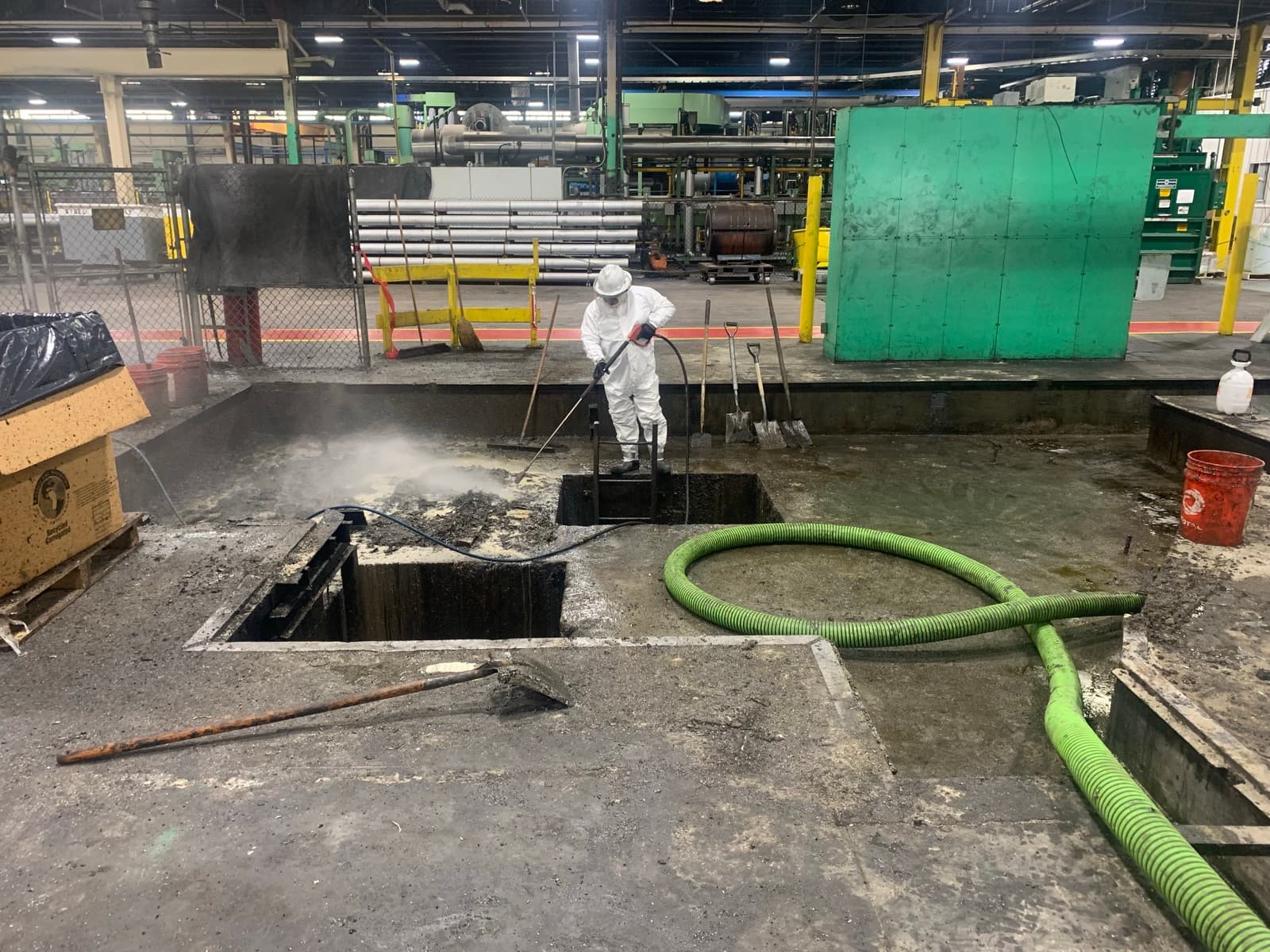
Industrial cleaning at Cowart means matching the method to the deposit, not selling whichever rig is on the truck. Vacuum recovery, high-pressure washing, hydroblasting from 10,000 to 40,000 PSI, and chemical cleaning are all in the toolkit, and the cleaning plan names which one (or which combination) gets used before a crew arrives on site. Wrong method costs time and wears equipment; the right method ends the job in one pass.
Our industrial cleaning services cover the full range of non-hazardous buildup found inside operating plants: scale and mineral deposits in heat exchangers and boilers, sludge in pits and sumps, hardened residue in tanks and reactors, hydrocarbon films on equipment, biological fouling in cooling towers, and process buildup on piping and ductwork. Confined-space entry, UST and AST cleaning, lockout/tagout coordination, and isolation work are routine, most industrial cleaning jobs touch at least one of those, and our crews carry the credentials for all of them.
Cowart Industrial Services has been doing this work since 1974. We're a family-operated company based in Carrollton, Georgia, with our own treatment plant on site and our own DOT number on every truck. That matters because it means cleaning, transport, treatment, and disposal all stay under one compliance umbrella, one phone number, one paper trail, one vendor on your audit. Most cleaning contractors stop at the door of the plant and hand the waste off to someone else. We don't.
How we choose the right cleaning method
Industrial cleaning is a method-selection problem first and a labor problem second. The wrong method either fails to remove the deposit, damages the substrate, or generates a waste stream that costs more to dispose of than the cleaning saved. Before a crew is dispatched, we build a written cleaning plan that names the substrate, the deposit, the access method, the target end-state, and the disposal path for whatever comes out. The plan is the deliverable, the cleaning is the execution.
Vacuum recovery is the right tool when the material is loose or already liquid: tank bottoms, sumps, trenches, spills, and bulk solids that can be drawn into a tank truck. Pressure washing, up to about 4,000 PSI, handles general cleaning, light grease, and architectural-grade industrial surfaces. Hydroblasting takes over above 10,000 PSI when scale, hardened deposits, or failed coatings have to come off, and runs up to 40,000 PSI for surface preparation that meets SSPC SP-WJ standards before recoating. Chemical cleaning is reserved for what mechanical methods can't reach: closed circuits, fouled heat exchangers, biological growth in cooling towers, and process residues that need to be dissolved rather than blasted.
Most real plant jobs use two or more of these in sequence. A heat exchanger going into a turnaround might get a chemical pre-soak to loosen scale, a hydroblast pass to remove what the chemistry knocked loose, and a vacuum recovery on the spent rinse water. We're set up to run the whole sequence under one work order with one crew supervisor, not three separate vendors and three separate manifests.
Why a single-DOT, in-house treatment model matters
Most industrial cleaning contractors are good at cleaning. They are not, by and large, set up to take the waste with them. The recovered material gets pumped into a third-party tanker, hauled to a third-party treatment facility, and manifested across three companies, each of which has to be auditable, insured, and compliant. When something goes wrong on the disposal side, the trail crosses vendor lines.
Cowart runs the entire chain. Our own DOT number is on every truck that leaves your facility. Recovered water, sludge, and slurries come back to our Carrollton, Georgia treatment plant, are characterized in-house, and disposed under our manifests. For your compliance department, that's one vendor on the audit, one set of insurance certificates to file, one phone call if EPA shows up asking questions. It also keeps disposal cost predictable, third-party haulers and treatment facilities price-shock customers; we don't.
What our crews carry
Every cleaning crew runs with HAZWOPER-40, OSHA-30, DOT Hazmat, EPA RCRA awareness, and confined-space training current and documented. We send those certs to your safety department before the first truck rolls, not after the first incident. Site-specific training (your LOTO procedures, your PPE matrix, your contractor orientation) is layered on top of the baseline credentials. Crew leads carry CSE supervisor designations where required.
Equipment is matched to the credentials. Hydroblasting rigs go out with the safety perimeter, dump valves, dead-man controls, and operator face shields the standard calls for. Vacuum trucks are inspected and pressure-tested on schedule. Confined-space jobs are run with continuous atmospheric monitoring, retrieval systems, and a dedicated standby attendant on every entry. The safety case is built into the quote, it isn't a line item we cut to win a bid.
Industries we serve
Where we work
- Atlanta
- Augusta
- Columbus
- Macon
- Savannah
- Carrollton
- LaGrange
- Newnan
- Rome
- Birmingham
- Mobile
- Montgomery
- Huntsville
- Tuscaloosa
- Anniston
- Knoxville
- Chattanooga
- Nashville
- Memphis
- Columbia
- Charleston
- Greenville
- Spartanburg
- Charlotte
- Raleigh
- Greensboro
- Wilmington
- Jacksonville
- Tampa
- Pensacola
- Panama City
- Jackson
- Meridian
- Pascagoula
- Gulfport
- Louisville
- Lexington
- Owensboro
- Paducah
Common questions
Quick answers on scope, method, safety, and turnaround. Don’t see your question? Ask us directly.
Q-01What does industrial cleaning include?
Industrial cleaning covers the removal of process buildup, scale, sludge, residue, and contamination from operating plant equipment and facilities. At Cowart that includes vacuum recovery, pressure washing, hydroblasting from 10,000 to 40,000 PSI, chemical cleaning, confined-space entry, tank and vessel cleaning, pit and sump cleanout, and heat-exchanger and boiler service. The work is matched to the deposit and substrate, one method rarely covers everything.
Q-02How is industrial cleaning different from commercial cleaning?
Commercial cleaning is janitorial work, floors, restrooms, offices, light facility maintenance. Industrial cleaning is process work inside operating plants: cleaning the equipment that makes the product, not the spaces around it. Industrial cleaning requires HAZWOPER and confined-space credentials, specialized equipment (vacuum trucks, hydroblasting rigs, chemical systems), and the ability to characterize and dispose of the recovered material as a regulated waste stream. The two trades don't overlap in practice.
Q-03What industries do you clean for?
Refineries and petrochemical plants, power generation (coal, gas, biomass), pulp and paper mills, steel and aluminum mills, chemical manufacturing, food and beverage processors, pharmaceutical plants, automotive and assembly facilities, textile and carpet mills, mining and aggregates, municipal water and wastewater treatment, and general manufacturing across the Southeastern US.
Q-04Are your industrial cleaning crews certified?
Yes. Every crew carries HAZWOPER-40, OSHA-30, DOT Hazmat, EPA RCRA awareness, and confined-space credentials. Crew leads add CSE supervisor designations where the job requires it. Certifications and current insurance certificates are sent to your safety department before the first truck rolls on site, not after an incident.
Q-05Do you handle the waste stream from industrial cleaning?
Yes, that's the part that makes Cowart different. Most industrial cleaning contractors stop at the door and hand the recovered material to a third-party hauler and a third-party treatment facility. We bring it back to our own treatment plant in Carrollton, Georgia under our own DOT number, characterize it in-house, and dispose it under our manifests. Cleaning, transport, treatment, and disposal all stay under one compliance umbrella.
Q-06Can you support plant turnarounds and outages?
Yes. Plant turnarounds are a core part of our work. We mobilize multiple crews, hydroblasting rigs, vacuum trucks, and chemical-cleaning equipment for shutdowns that compress weeks of cleaning into a 5-14 day window. We coordinate with your turnaround planner, work to the schedule, and provide a single point of contact for cleaning scope. 24-hour operation is standard during outages.
Q-07What states do you serve for industrial cleaning?
Cowart Industrial provides industrial cleaning services across the Southeastern US, Georgia, Alabama, Tennessee, South Carolina, North Carolina, Florida, Mississippi, and Kentucky. Our base is in Carrollton, GA, west of Atlanta, and we maintain 24-hour emergency dispatch for plant breakdowns, spills, and turnaround support.
Q-08How long have you been in business?
Cowart Industrial Services has been in continuous operation since 1974, over 50 years of family-operated industrial environmental services in the Southeast. The company has grown from a single vacuum truck to a multi-state operation with its own treatment plant, its own DOT number, and a fleet covering the full range of industrial cleaning methods, but the ownership and the family-operated character haven't changed.