Industrial Chemical Cleaning
Chemical cleaning and descaling for heat exchangers, boilers, cooling towers, tanks, and piping. HAZWOPER crews, plant-safe methods, Southeast-wide.
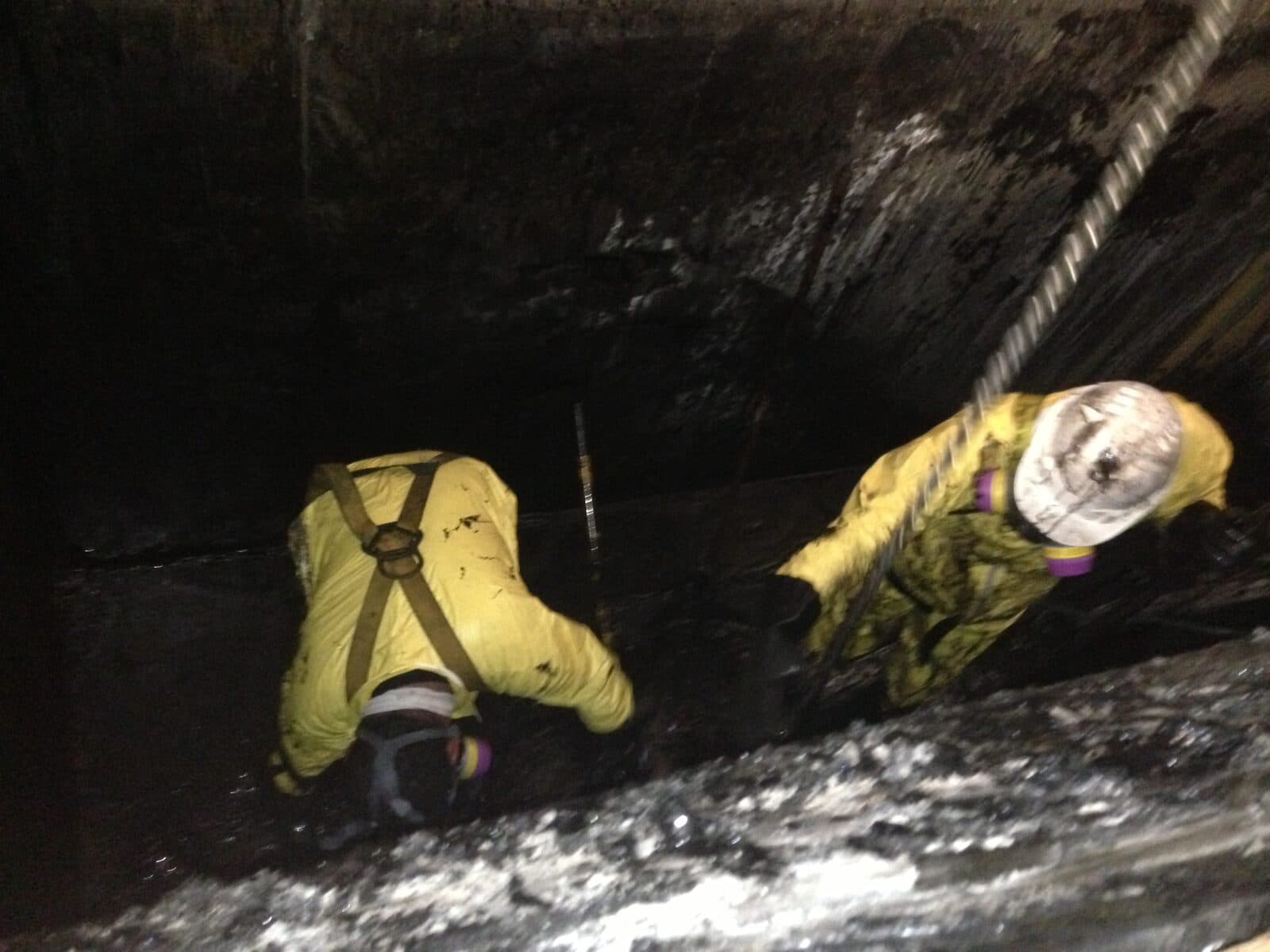
Cowart Industrial provides chemical cleaning for industrial process equipment where mechanical methods, hydroblasting, vacuum recovery, manual cleaning, won't reach or won't return the surface to spec. Our crews apply acids (hydrochloric, sulfamic, citric, formic, phosphoric, hydrofluoric where required), caustics, organic solvents, biocides, and specialty chemistries to dissolve scale, mineral deposits, biological fouling, hydrocarbon residue, and process buildup from the inside of operating equipment, often without disassembly. The work is engineered, not improvised: every chemical cleaning scope starts with a written procedure that names the substrate, the deposit profile, the cleaning chemistry, the contact time, the temperature, the rinse sequence, and the pass/fail criteria for completion.
Typical applications include heat-exchanger descaling (shell-side and tube-side), boiler tube cleaning, fired-boiler waterwall passivation, cooling-tower fill cleaning and biocide treatment, tank passivation and acid pickling for new stainless installations, process piping system cleaning, reactor and process vessel decontamination, and pre-commissioning chemical cleaning for new equipment going into service. We work closely with facility process engineers and equipment OEMs to match the chemistry to the substrate, wrong chemistry can damage stainless, embrittle carbon steel, attack elastomer seals, or void warranty on lined equipment, so the selection isn't ad-hoc.
The work runs under full HAZWOPER-40, OSHA-30, and confined-space credentials. Cleaning solutions, rinse waters, and recovered residue are collected at the point of generation, no discharge to facility drains, no surprises in your wastewater permit, and transported under Cowart's own DOT number to our treatment plant in Carrollton, Georgia or to a permitted disposal facility appropriate to the spent chemistry. The entire process, including the waste stream, stays under one compliance umbrella. That matters because chemical cleaning generates regulated waste, and the disposal path is usually the part that gets contractors in trouble, not the cleaning itself.
Why chemistry beats mechanical cleaning for certain jobs
Mechanical cleaning, hydroblasting, brushing, scraping, sandblasting, only works on surfaces a tool can reach. The inside of a tube bundle, the closed circuit of a boiler waterwall, the fill of a cooling tower, the internals of a reactor, those are physically inaccessible to a wand or a brush. Chemistry, by contrast, fills the volume. Pump the right cleaning solution through the equipment at the right temperature for the right contact time, and it dissolves what's in there. Pump rinse water, and you flush the residue out. The equipment never has to come apart.
The classic case is heat exchanger descaling. Calcium carbonate scale on the tube-side of a shell-and-tube exchanger reduces heat transfer (a 1 mm scale layer can drop fuel efficiency by ~9% on a fired boiler), and over time blocks tubes outright. Mechanical cleaning means pulling the bundle, hydroblasting the tubes individually, and reinstalling, a multi-day job that requires bundle handling equipment. Chemical cleaning in place means closing the tube-side off, filling it with inhibited HCl (or sulfamic acid, depending on the metallurgy), circulating for 4-8 hours, neutralizing, rinsing, and putting the exchanger back in service. Same result, often in one shift instead of three.
Same logic applies to fired-boiler chemical cleaning, cooling-tower fill cleaning, and process-piping system cleaning. The cost trade-off favors chemistry whenever the equipment is hard to disassemble and the deposit is chemistry-removable.
Why chemistry selection matters
The wrong chemistry costs more than no cleaning at all. Hydrochloric acid on stainless steel risks chloride stress-corrosion cracking; you use sulfamic or citric instead. Caustic on aluminum dissolves the metal; you use a specifically inhibited cleaner. Formic acid passes through copper-bearing brass without damage where HCl would attack it. Hydrofluoric acid is the only practical chemistry for silica-bearing scale but requires PPE and handling protocols that most contractors don't have. The chemistry has to match the substrate's metallurgy and the deposit's composition, and that match is verified, not assumed.
Cowart writes a cleaning procedure for every chemical cleaning scope before the chemistry is mixed. The procedure names the deposit (typically based on a deposit sample analyzed for composition), the substrate (verified from drawings or sampling), the candidate chemistries, the selected chemistry with rationale, the concentration, the temperature, the contact time, the inhibitor package, and the rinse sequence. The procedure is reviewed with the facility's process engineer and approved before circulation begins. That's the difference between cleaning and equipment damage.
Spent chemistry, the disposal problem most contractors hand off
Chemical cleaning generates a regulated waste stream: spent acid, spent caustic, dissolved metals, oxidized organic residue, sometimes hazardous constituents depending on what came off the equipment. Most chemical cleaning contractors load the spent chemistry into a vacuum truck and call a third-party hazmat hauler. The customer ends up with a manifest crossing two or three vendors, a disposal cost the contractor doesn't control, and a waste profile they have to characterize themselves.
Cowart's model is different. Spent chemistry is collected on site by our own crew, characterized in-house, and routed to the right disposal path under our DOT number. Non-hazardous spent chemistry (the majority of routine descaling and passivation work) goes to our treatment plant in Carrollton, Georgia for neutralization and discharge under permit. Hazardous spent chemistry (HF residue, heavy-metals-laden caustic, specific solvents) goes to a permitted hazardous facility under our coordinated handoff, but the coordination is ours, not yours. One contractor's name on the cleaning, one contractor's documentation on the disposal.
Industries we serve
Where we work
- Atlanta
- Augusta
- Columbus
- Macon
- Savannah
- Carrollton
- LaGrange
- Newnan
- Rome
- Birmingham
- Mobile
- Montgomery
- Huntsville
- Tuscaloosa
- Anniston
- Knoxville
- Chattanooga
- Nashville
- Memphis
- Columbia
- Charleston
- Greenville
- Spartanburg
- Charlotte
- Raleigh
- Greensboro
- Wilmington
- Jacksonville
- Tampa
- Pensacola
- Panama City
- Jackson
- Meridian
- Pascagoula
- Gulfport
- Louisville
- Lexington
- Owensboro
- Paducah
Common questions
Quick answers on scope, method, safety, and turnaround. Don’t see your question? Ask us directly.
Q-01What is industrial chemical cleaning?
Industrial chemical cleaning uses acids, caustics, solvents, or specialty chemistries to dissolve scale, mineral deposits, biological fouling, hydrocarbon residue, and process buildup from the inside of operating equipment. It's used when mechanical cleaning (hydroblasting, manual cleaning) can't reach the deposit, typically inside heat exchangers, boiler tubes, cooling towers, process piping, and reactors. Done correctly, it cleans the equipment without disassembly and without damaging the substrate.
Q-02What can be chemically cleaned?
Heat exchangers (shell- and tube-side), fired boilers, cooling tower fill, process piping systems, reactors and process vessels, tank interiors, condensers, evaporators, fin-fans, distillation columns, and most closed-circuit process equipment. If the equipment can be isolated and filled with a circulating solution, it can usually be chemically cleaned.
Q-03What chemistries do you use?
Hydrochloric acid for carbon-steel descaling; sulfamic and citric acids for stainless-compatible work; formic acid for copper-bearing alloys; phosphoric acid for passivation and rust conversion; hydrofluoric acid for silica scale (specialty PPE and protocols required); inhibited caustics for organic and grease deposits; solvents for hydrocarbon residue. Chemistry is selected by writing a cleaning procedure that matches the substrate and the deposit, not by reaching for what's on the truck.
Q-04Will chemical cleaning damage my equipment?
Not when the chemistry, concentration, temperature, contact time, and inhibitor package are correctly matched to the substrate and the deposit. Damage happens when the wrong chemistry is selected (HCl on stainless, caustic on aluminum, uninhibited acid on carbon steel) or when contact time is exceeded. We write a cleaning procedure for every scope and have it reviewed by your process engineer before circulation begins. The procedure is the safety case.
Q-05How long does chemical cleaning take?
Most in-place chemical cleaning runs in a single 8-24 hour outage window. Heat-exchanger descaling typically takes 4-8 hours of circulation plus rinse; boiler chemical cleaning runs 12-24 hours depending on scope; pre-commissioning cleans on new equipment can run 12-48 hours through multiple chemistry steps. The full window includes setup, cleaning, neutralization, rinsing, and pass-criteria sampling.
Q-06What happens to the spent cleaning chemistry?
Spent chemistry is collected at the point of generation (no discharge to facility drains), characterized in-house, and routed to disposal under Cowart's own DOT number. Non-hazardous spent chemistry goes to our treatment plant in Carrollton, GA for neutralization and discharge under permit; hazardous spent chemistry goes to a permitted hazardous facility under our coordinated handoff. The customer sees one contractor on the cleaning and one contractor's documentation on the disposal.
Q-07Do you do pre-commissioning chemical cleaning for new equipment?
Yes. New boilers, heat exchangers, and process systems often require alkaline degreasing, acid pickling, passivation, and a final demineralized rinse before going into service. We run pre-commissioning scopes coordinated with the EPC contractor and the equipment OEM, with sample-based pass criteria documented and signed off at each step.
Q-08What states do you serve for chemical cleaning?
Georgia, Alabama, Tennessee, South Carolina, North Carolina, Florida, Mississippi, and Kentucky. Chemical cleaning work is dispatched from Carrollton, GA with mobile chemistry pumps, heating units, and rinse-water staging trailers that travel with the crew.