Industrial Roll-Off Container
Roll-off containers for plants and industrial sites: 20, 30, and 40 yard boxes, scheduled swaps, disposal included. Serving Georgia and the Southeast.
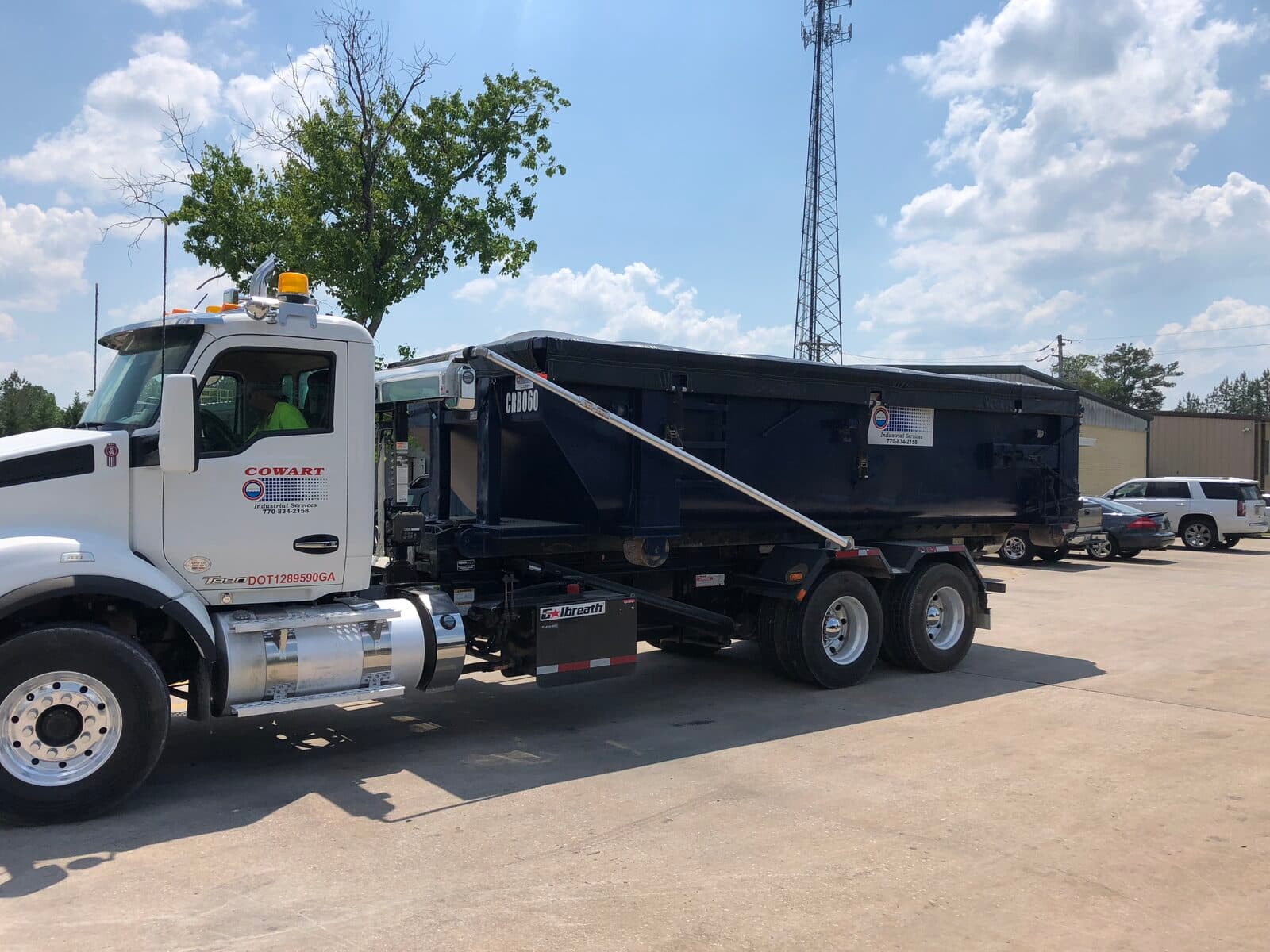
Cowart Industrial provides roll-off container service for industrial facilities across an 8-state Southeastern footprint. The roll-off fleet covers 20, 30, and 40-yard open-top boxes, sized for the work, not just whatever's on the lot. Standard delivery is within 24 hours of the call; emergency same-day service is available across most of our service area, dispatched from Carrollton, GA.
Roll-off containers handle non-hazardous solid waste: demolition debris, plant cleanout material, dewatered sludge cake, contaminated soil suitable for landfill, general project waste, refractory debris, packaging and pallets, and most bulk solid streams. We do not accept hazardous materials, wet sludge (use a sealed vacuum box instead), or free-flowing liquids in open-top roll-offs, for those streams, dispatch will route you to the right container.
Containers come with the documentation industrial customers expect: delivery and pickup tickets, weight slips from the disposal facility, and certificates of disposition once the load is offloaded at the permitted disposal site. Every truck runs under Cowart's own DOT number, so the manifest and disposition paperwork stay under one contractor. Whether you're running a one-time cleanout or a recurring schedule for a production line, the paperwork standard is the same.
What size roll-off do you need?
Roll-off sizing isn't just about volume, it's about the weight of the material, the access at the loading site, and how often the box gets pulled. A 20-yard box is the right call for heavy material (concrete, soil, refractory) where weight limits hit before the box is full. A 30-yard works for mixed solids of moderate density. A 40-yard is for lighter, bulkier material (packaging, demolition wood, debris) where volume runs out before weight does.
Most plant cleanouts and turnaround work uses 30-yard boxes as a default. Demolition jobs and large-scale renovation lean toward 40-yard. Soil-heavy work like contaminated-soil removal usually stages 20-yard boxes with multiple pulls. If you're not sure, tell dispatch what the material is and the rough volume, they'll match the box and the pull schedule to the job.
What we accept and what we don't
Open-top roll-off containers are for non-hazardous solid waste. Accepted streams include demolition debris, contaminated soil that's been characterized for landfill acceptance, dewatered sludge cake, plant cleanout debris, refractory material, packaging, dewatered process residuals, and general industrial bulk solids. The acceptance criterion is dry-handling and non-hazardous classification, if it weeps liquid or doesn't pass paint-filter testing, it needs a sealed vacuum box instead, not a roll-off.
We don't accept: free-flowing liquids, wet sludge that hasn't been solidified, hazardous waste (RCRA, characteristic, PCB, radioactive), or anything our partner disposal facilities aren't permitted to receive. If your material classification is on the edge, run a profile before pickup, out-of-profile material gets rejected at the disposal facility and the customer eats the round-trip transport cost.
Plant turnarounds and project work
Plant turnarounds are a heavy roll-off application. Shutdowns produce large volumes of cleanout material in compressed windows, refractory removal, equipment cleaning residue, packaging from new parts, demolition debris from the work itself. We stage multiple boxes on site for the duration of the turnaround, with a pull schedule that keeps the work area cleared without bottlenecking the maintenance crews. One dispatcher coordinates deliveries, pulls, and weight-slip aggregation across the entire shutdown.
Project work runs similarly. Site preparation, demolition, new construction, and capital projects all generate roll-off-friendly waste streams. We coordinate with the general contractor or facility project manager on box placement, pull cadence, and disposal documentation. The work happens under one work order, one Certificate of Insurance, one paper trail.
Industries we serve
Where we work
- Atlanta
- Augusta
- Columbus
- Macon
- Savannah
- Carrollton
- LaGrange
- Newnan
- Rome
- Birmingham
- Mobile
- Montgomery
- Huntsville
- Tuscaloosa
- Anniston
- Knoxville
- Chattanooga
- Nashville
- Memphis
- Columbia
- Charleston
- Greenville
- Spartanburg
- Charlotte
- Raleigh
- Greensboro
- Wilmington
- Jacksonville
- Tampa
- Pensacola
- Panama City
- Jackson
- Meridian
- Pascagoula
- Gulfport
- Louisville
- Lexington
- Owensboro
- Paducah
Common questions
Quick answers on scope, method, safety, and turnaround. Don’t see your question? Ask us directly.
Q-01What sizes of roll-off containers do you offer?
20, 30, and 40-yard open-top boxes. 20-yard for heavy material (concrete, soil, refractory) where weight limits hit early; 30-yard as the default for mixed solid waste of moderate density; 40-yard for lighter bulky material (packaging, demolition wood) where volume runs out before weight does.
Q-02How fast can you deliver a roll-off?
Standard delivery is within 24 hours of the call. Same-day delivery is available across most of our 8-state Southeast service area when dispatch is called by mid-morning. For plant turnarounds and projects, we pre-schedule the delivery and pull cadence around the work plan.
Q-03What can I put in a roll-off?
Non-hazardous solid waste, demolition debris, contaminated soil characterized for landfill acceptance, dewatered sludge cake, plant cleanout material, refractory, packaging, dewatered process residuals, and general industrial bulk solids. Anything that's dry-handling and non-hazardous. Free-flowing liquids and wet sludge need a sealed vacuum box, not an open-top roll-off.
Q-04What can't I put in a roll-off?
Hazardous waste (RCRA, characteristic, PCB, radioactive), free-flowing liquids, wet sludge that hasn't been solidified, or anything out of profile with the receiving disposal facility's permit. If the material classification is on the edge, run a profile before pickup, out-of-profile loads get rejected at the disposal facility and the customer pays the round trip.
Q-05Do you provide weight tickets and disposal records?
Yes. Delivery and pickup tickets, weight slips from the disposal facility, and certificates of disposition come standard with every roll-off job. For sites under permit (RCRA generator, NPDES, industrial pretreatment), documentation cadence and format match the permit.
Q-06Can you support plant turnarounds with multiple boxes?
Yes, turnaround work is a core roll-off application. We stage multiple boxes on site for the duration of the shutdown, coordinate pull schedules with the maintenance plan, and aggregate documentation into a single packet at the end. One dispatcher, one work order, one paper trail.
Q-07What states do you deliver roll-offs to?
Georgia, Alabama, Tennessee, South Carolina, North Carolina, Florida, Mississippi, and Kentucky. Dispatch is from Carrollton, GA. Delivery time varies with distance; the eastern half of our region typically gets same-day or next-day service.