
21,000-Gallon Frac Tank Rental
21,000-gallon frac tank rental across the Southeast for industrial liquid storage, turnaround projects, wastewater staging, and emergency containment.
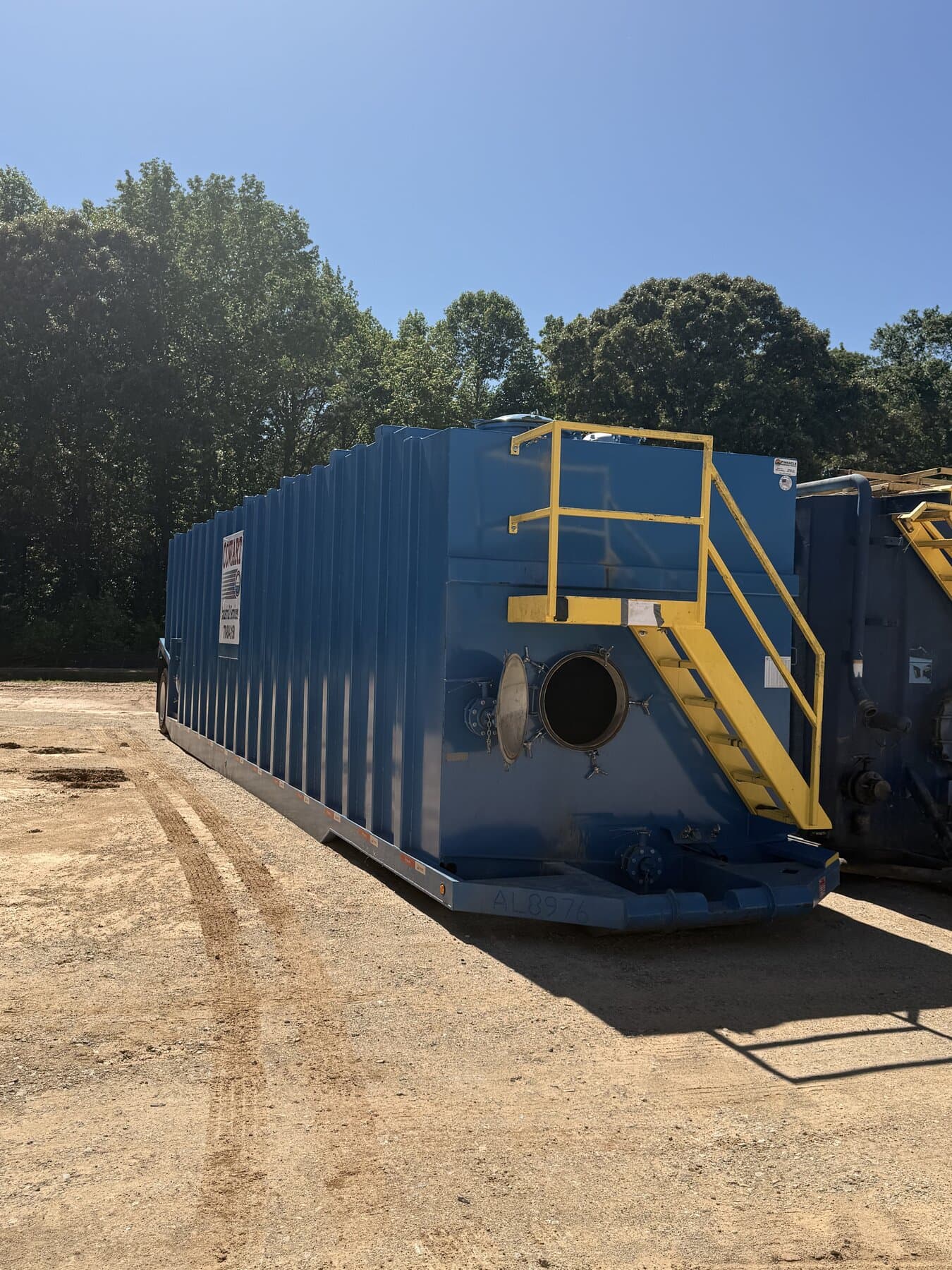
Cowart Industrial provides 21,000-gallon frac tank rental for industrial sites that need temporary on-site liquid storage. The standard tank is steel-walled with internal epoxy lining, manway access, sample ports, and standard fittings that mate to vacuum trucks, on-site pumps, and process hoses. Each tank holds the equivalent of 500 barrels of liquid, enough capacity to stage a meaningful volume of process water, wastewater, or project liquid without the access constraints of permanent tankage.
Frac tank applications include process water storage during plant turnarounds, wastewater staging before treatment or disposal, project water supply for hydroblasting and line-flushing operations, secondary containment for facility maintenance, holding capacity for spill response, dewatering tank for hydrovac and excavation projects, and temporary capacity expansion for facilities running over their normal tankage. Multiple tanks can be manifolded together for larger volumes, talk to dispatch if your project needs 50,000 to 200,000+ gallons of staged liquid.
Tanks are washed and inspected between rentals. Standard rental includes delivery to your site, level set on prepared ground, and pickup at end of rental. Optional services include level monitoring, transfer pumping, end-of-rental cleanout, and integrated vacuum-truck pickup of the tank contents. Pair frac tank rental with our vacuum truck service and treatment plant for a fully managed liquid handling program, one vendor on the rental, the trucks, the treatment, and the disposal.
What a 21,000-gallon frac tank is built for
The 21,000-gallon (500 bbl) frac tank is the industry-standard portable storage unit for industrial liquids. The dimensions, weight, and configuration are standardized across the rental market because the use cases are common: temporary capacity expansion, project staging, turnaround water management, dewatering, and containment. A single tank ships on a flatbed or roll-off chassis, sets on prepared ground without a foundation, and is connected to your operation through standard 4-inch and 6-inch flanged or camlock fittings.
The internal epoxy lining handles most non-hazardous industrial liquids, process water, wastewater, cooling water, dewatering effluent, rinse water, and project water. Chemical compatibility for specific streams is verified before deployment; for aggressive chemistry, specialty-lined tanks or coated alternatives are available on request. The tank's external steel construction is sized for full hydrostatic load, 21,000 gallons of water weighs about 87 tons, so site preparation (level, load-bearing) matters and is confirmed before drop.
Typical applications across our customer base
Plant turnarounds are the biggest use case. A 5- to 14-day turnaround often produces and consumes more water than the facility's normal tankage can absorb, hydroblasting feed, equipment flushwater, dewatering volume, contaminated stormwater from secondary containment, holding for treatment scheduling. One or two frac tanks staged for the turnaround keep the schedule moving without forcing trucks to wait for tank capacity.
Wastewater holding is the next-largest application. When a facility's wastewater generation exceeds its treatment cadence, a process upset, a seasonal spike, a delayed haul-off, a frac tank gives you buffer capacity until trucks can be scheduled. The tank can be pumped down progressively as Cowart vacuum trucks run loads to the treatment plant.
Project water supply for hydroblasting and line flushing rounds out the heavy use cases. Hydroblasting rigs consume thousands of gallons per shift; line flushing operations sometimes consume more. Staging clean water in a frac tank on-site means the rig isn't waiting on facility water supply or competing with operations for capacity.
What a fully managed frac tank program looks like
Most frac tank rental companies are equipment-only. They drop the tank and pick it up. Cowart's model is different: the tank is part of a service package that includes the vacuum trucks that load and unload it, the treatment plant that processes the contents, and the disposal documentation that closes the loop. For a facility running a turnaround, that means one vendor handles tank rental, water supply, wastewater pickup, treatment, and disposal, instead of three or four separate contracts.
On the operational side, the integration matters at small scale too. A frac tank that's holding wastewater for treatment doesn't need a separate vendor to come empty it; the same Cowart dispatcher who scheduled the rental schedules the pickup. The same DOT number that brought the tank takes the load. The same Certificate of Insurance covers the whole program. Pricing is predictable because the markup chain is one company instead of three.
Industries we serve
Where we work
- Atlanta
- Augusta
- Columbus
- Macon
- Savannah
- Carrollton
- LaGrange
- Newnan
- Rome
- Birmingham
- Mobile
- Montgomery
- Huntsville
- Tuscaloosa
- Anniston
- Knoxville
- Chattanooga
- Nashville
- Memphis
- Columbia
- Charleston
- Greenville
- Spartanburg
- Charlotte
- Raleigh
- Greensboro
- Wilmington
- Jacksonville
- Tampa
- Pensacola
- Panama City
- Jackson
- Meridian
- Pascagoula
- Gulfport
- Louisville
- Lexington
- Owensboro
- Paducah
Common questions
Quick answers on scope, method, safety, and turnaround. Don’t see your question? Ask us directly.
Q-01How big is a standard frac tank?
Our standard frac tank is 21,000 gallons, also called a 500-barrel (500 bbl) tank. The dimensions and weight are standardized across the rental market so the tank ships on a flatbed or roll-off chassis and sets on prepared ground without a foundation. A single tank handles most project-scale liquid storage needs; multiple tanks can be manifolded for larger volumes.
Q-02What can I store in a frac tank?
Process water, wastewater, cooling water, dewatering effluent, rinse water, hydroblasting feed water, contaminated stormwater, drilling fluids, and most non-hazardous industrial liquids. The internal epoxy lining handles standard industrial chemistry; aggressive or specialty chemistry is matched to specialty-lined tank options on request.
Q-03Can I rent multiple tanks for a large project?
Yes. Multiple frac tanks can be manifolded together for projects that need 50,000+ gallons of staged liquid. We've supported turnarounds and projects requiring 4-10 tanks staged together. Talk to dispatch about layout, fitting requirements, and delivery sequence, large multi-tank setups need coordination with the site logistics plan.
Q-04Do you handle the wastewater pickup at the end of the project?
Yes, that's the integrated service model. Cowart's vacuum trucks empty the tank under our own DOT number and transport the contents to our treatment plant in Carrollton, Georgia or a permitted disposal facility. One vendor handles the rental, the pickup, the transport, and the treatment.
Q-05How long can I rent a frac tank for?
Rental terms run from a few days (project staging, emergency response) to multiple months (long-term capacity expansion, dewatering programs). Pricing is by the day, with discounts for longer-term commitments. Most turnaround rentals run 1-3 weeks; standby capacity rentals often run 30+ days.
Q-06What kind of site preparation do I need?
A flat, level, load-bearing surface. The water alone in a full 21,000-gallon tank weighs about 87 tons, before counting the tank itself, so site bearing capacity matters. Prepared gravel or asphalt is preferred; soft soil or unprepared fill is not acceptable for sustained rental. We confirm site conditions during the pre-delivery walkthrough.
Q-07Are frac tanks cleaned between rentals?
Yes. Tanks are washed and inspected between rentals. Lined tanks coming off duty for one customer aren't deployed to the next customer until they've been cleaned and the lining condition verified. For specialty chemistry, additional dedicated-service options are available.
Q-08What states do you rent frac tanks in?
Georgia, Alabama, Tennessee, South Carolina, North Carolina, Florida, Mississippi, and Kentucky. Delivery, level set, pickup, and integrated vacuum-truck service are all dispatched from Carrollton, GA.