Industrial Decontamination
Industrial line flushing and decontamination across the Southeast for changeovers, turnarounds, and decommissioning, purge, sample, dispose.
Cowart Industrial provides line flushing and industrial decontamination service for process equipment that has to be cleaned to a defined end-state. The work covers three distinct scopes that look similar but have different acceptance criteria: product-changeover flushes (clearing one product from a line before introducing another, with cross-contamination thresholds set by the receiving product), turnaround decontamination (purging hazardous or hot process material before vessel entry or mechanical work, with safety-driven exposure criteria), and end-of-life decommissioning flushes (preparing equipment for demolition, sale, or relocation, with regulatory disposal criteria). Each scope is engineered to its own purge sequence, what works for a changeover doesn't necessarily satisfy a vessel-entry decon.
Flushing media range from water and steam through specialty solvents and decontamination chemistries, depending on the residue, the substrate, and the acceptance criteria. Our crews work with facility process engineers to write the purge sequence before the work starts: which media, in what order, at what temperature, for how long, with what sampling protocol. Wrong sequence can leave residue that fails the changeover sample, damage seals or elastomers, or fail the regulatory clearance for vessel entry. Right sequence ends the job once with documentation that satisfies the customer's QA team and (where applicable) the regulator.
Spent flush solutions and decontamination wastes are collected at the point of generation, no discharge to facility drains, no surprise loading on the wastewater permit, and transported under Cowart's DOT number to our treatment plant in Carrollton, Georgia or to a permitted hazardous facility under coordinated handoff for the small fraction of decon work that generates regulated hazardous waste. The work runs under HAZWOPER-40, OSHA-30, and confined-space certification; for vessel-entry decon (the most safety-critical scope), atmospheric monitoring is continuous and standby attendants are on every entry.
The three scopes, and why they're different jobs
A product-changeover flush exists to make a piece of equipment safe to introduce a new product without contamination. The acceptance criterion is usually a chemical or microbiological sample showing the residual of the prior product is below a specified threshold. The flush sequence is driven by what the prior product was, what the new product is, and what the receiving QA team will sign off on. Most changeovers are done with water or steam through a defined sequence; some need solvent intermediates. The work is fast, usually one shift, and ends when the sample passes.
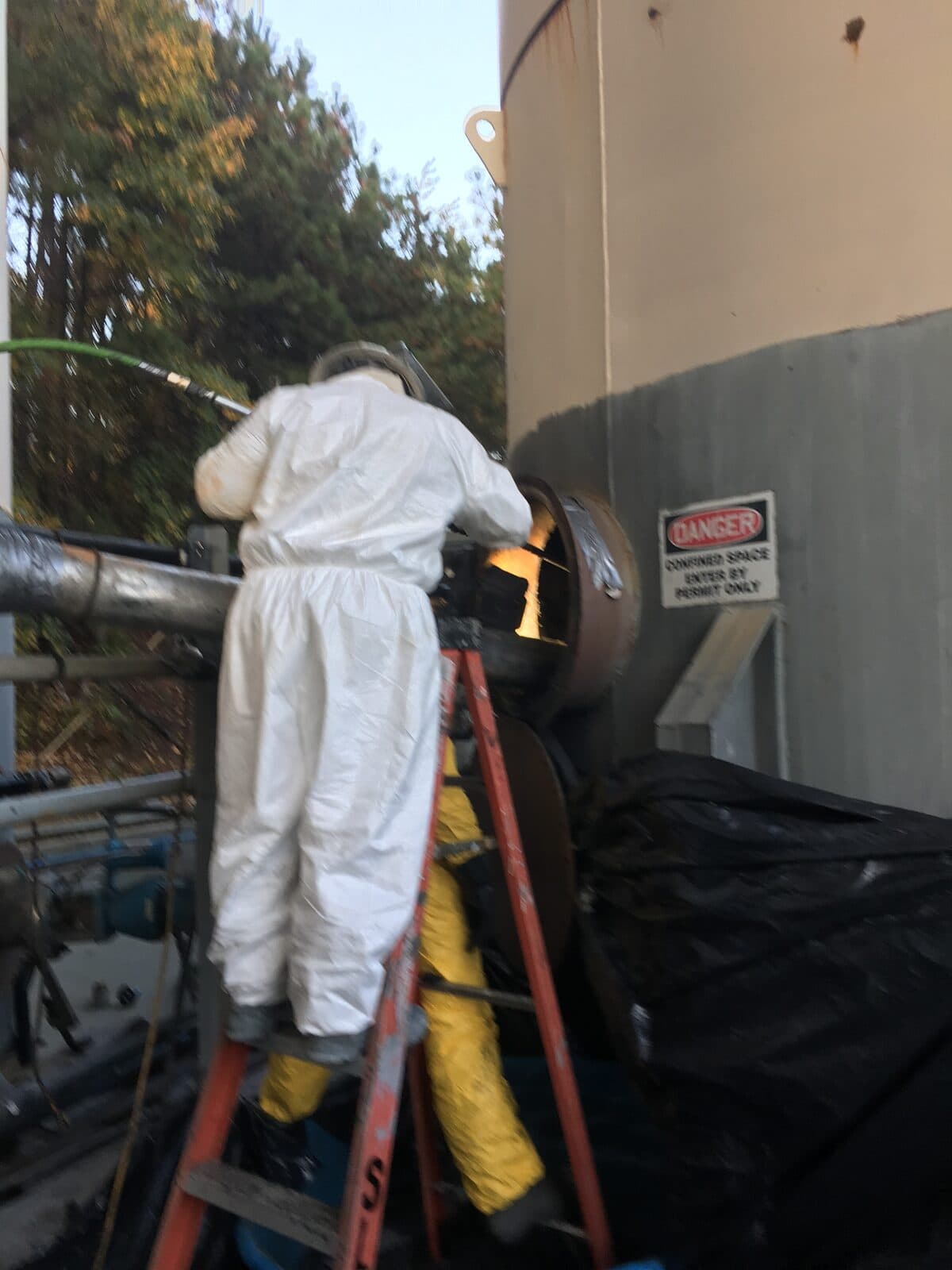
A turnaround decontamination is a different problem. The equipment is being opened for mechanical work or vessel entry, and the goal is to drive the contained material to a level safe for entry under permit. The acceptance criterion is exposure-driven, LEL, oxygen, toxic gas thresholds, and the work is done before the maintenance crew arrives. Steam-out, nitrogen purge, water flush, and chemical decontamination steps may all be involved depending on what was in the equipment. The sampling protocol satisfies safety procedures, not QA.
A decommissioning decon is a regulatory exercise. The equipment is leaving service, sold, demolished, or relocated, and the residual contamination has to be characterized and either cleaned to a regulatory threshold or disposed of along with the equipment. The acceptance criteria are set by environmental regulations (RCRA, TSCA, state programs) and the documentation has to satisfy the disposing or receiving party. This is the slowest scope and the most paper-intensive.
Sampling, the part that turns flushing into engineering
Flushing without sampling is just rinsing. The discipline that makes line flushing a real service is the sampling protocol that proves the equipment is at the required end-state. Pre-work samples establish the starting concentration; in-process samples track the cleaning progress; post-flush samples verify the acceptance criterion is met. Sampling locations are selected to be representative, typically multiple points in a line, not just the discharge, and chain-of-custody is documented for samples going to a third-party lab.
Done right, the sampling tells you when the job is done and gives you the documentation to defend the result. Done wrong, you either over-clean (wasted time and chemistry) or under-clean (fail the receiving QA sample, repeat the work, lose the schedule). Cowart's sampling protocols are written into the cleaning procedure before the work starts and reviewed with the customer's QA contact.
What happens to the spent flush
Flushing generates waste, sometimes a lot of it, especially on large process systems. The spent flush solution carries whatever was in the equipment, in whatever concentration the flush removed. For non-hazardous changeovers and routine decon, the spent flush goes to Cowart's treatment plant in Carrollton, Georgia for processing under our existing wastewater permit. For decommissioning work that involves regulated material, the spent flush is profiled, manifested, and shipped to a permitted hazardous facility under coordinated handoff.
Either way, the spent flush is captured at the equipment, collected into vacuum trucks or sealed boxes at the discharge, rather than discharged to your facility drains. That's important because facility wastewater systems are usually permitted for steady-state plant flows, not for concentrated flush slugs, and a flush going to the drain can show up as a permit excursion. Capturing the flush at source keeps your discharge clean and your wastewater operator out of an investigation.
Industries we serve
Where we work
- Atlanta
- Augusta
- Columbus
- Macon
- Savannah
- Carrollton
- LaGrange
- Newnan
- Rome
- Birmingham
- Mobile
- Montgomery
- Huntsville
- Tuscaloosa
- Anniston
- Knoxville
- Chattanooga
- Nashville
- Memphis
- Columbia
- Charleston
- Greenville
- Spartanburg
- Charlotte
- Raleigh
- Greensboro
- Wilmington
- Jacksonville
- Tampa
- Pensacola
- Panama City
- Jackson
- Meridian
- Pascagoula
- Gulfport
- Louisville
- Lexington
- Owensboro
- Paducah
Common questions
Quick answers on scope, method, safety, and turnaround. Don’t see your question? Ask us directly.
Q-01What is industrial line flushing?
Industrial line flushing is the controlled purge of process equipment, piping, tanks, vessels, heat exchangers, to remove residual product, contamination, or hazardous material. It's used for product changeovers (clearing one product before another), turnaround prep (purging equipment before vessel entry), and decommissioning (preparing equipment to leave service). The flush sequence is engineered to the specific process and contamination profile, with sampling to verify the end-state.
Q-02How is line flushing different from line jetting?
Line jetting uses high-pressure water to mechanically dislodge buildup from inside a pipe, scale, grease, sludge, roots, and recovers the dislodged material. Line flushing uses controlled volumes of water, steam, or specialty media to chemically purge product or contamination from inside a process system, with sampling to verify the end-state. Jetting is about clearing obstructions; flushing is about driving residual concentrations to a defined threshold.
Q-03Can you do vessel-entry decontamination?
Yes. Pre-entry decon is one of our core scopes, driving the residual atmosphere in a tank, reactor, or vessel down to safe-entry thresholds (LEL, oxygen, toxic gases) before the maintenance crew arrives. The work is run under HAZWOPER-40, OSHA-30, and confined-space certification, with continuous atmospheric monitoring and standby attendants for any entry-required step.
Q-04What sampling do you do for flushing work?
Pre-work samples establish the starting concentration; in-process samples track the cleaning progress; post-flush samples verify the acceptance criterion. Sampling locations are selected to be representative, chain-of-custody is documented for samples going to a third-party lab, and the sampling protocol is written into the cleaning procedure before the work starts.
Q-05What media do you use for flushing?
Water is the most common, used for routine changeovers and rinses. Steam is used for hot service and decontamination where temperature drives the cleaning. Specialty solvents (matched to the residue and substrate) are used when water/steam won't reach. Nitrogen purge supports inert-atmosphere work. The media sequence is engineered, not improvised.
Q-06Do you handle the spent flush solution?
Yes. Spent flush is captured at the equipment (not discharged to facility drains), characterized, transported under Cowart's DOT number, and disposed at our treatment plant in Carrollton, GA or at a permitted hazardous facility under coordinated handoff. The customer doesn't end up holding the spent flush waste.
Q-07Can you support pre-commissioning decon for new equipment?
Yes. New process equipment often requires a documented pre-commissioning clean before it goes into product service, alkaline degreasing, water rinse, passivation, demineralized rinse, sampling. We coordinate this scope with the EPC contractor and the equipment OEM, with sample-based pass criteria documented and signed off at each step.
Q-08Do you flush chilled water and condenser water loops for data center commissioning?
Yes. Pre-commissioning flushing of chilled water and condenser water loops is a growing scope for us, driven by data center construction across Georgia and the Southeast. We flush construction debris, mill scale, and preservative oils out of new piping, support passivation and cleanliness verification against the commissioning agent's acceptance criteria, and capture the flush water for disposal at our own treatment plant instead of sending it to the site's storm or sanitary system. We coordinate directly with the EPC contractor and the commissioning schedule.
Q-09What states do you serve for line flushing and decon?
Georgia, Alabama, Tennessee, South Carolina, North Carolina, Florida, Mississippi, and Kentucky. Decon crews are dispatched from Carrollton, GA with mobile sampling and chemistry equipment that travels with the team.