
Industrial Vacuum Trucks
Industrial vacuum truck service across the Southeast, wet/dry vacuuming, liquid recovery, air-mover dry-bulk transfer, and sealed vacuum boxes.
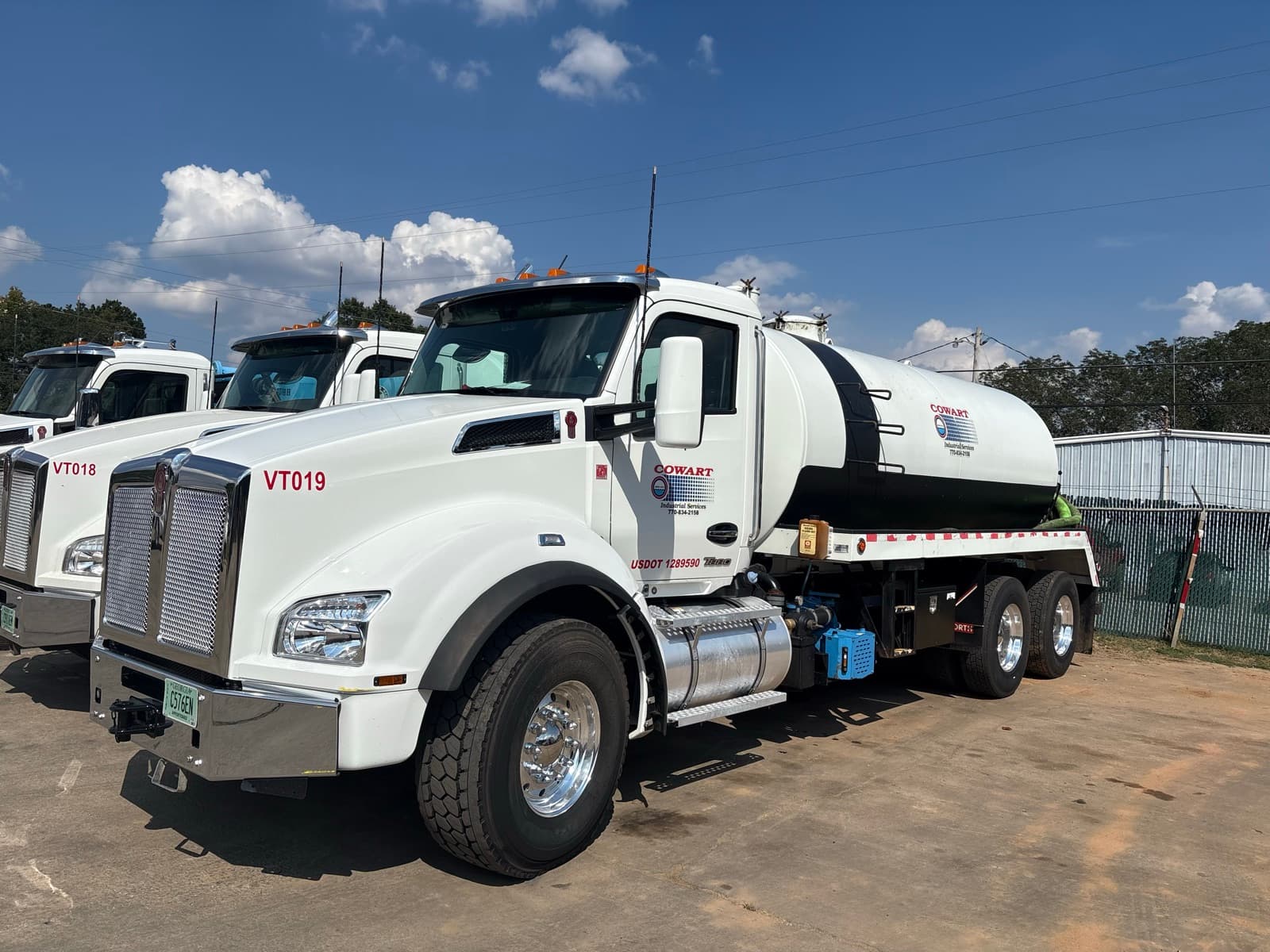
Cowart Industrial operates a full vacuum truck fleet from our Carrollton, Georgia headquarters, serving industrial customers across an eight-state Southeastern footprint. The fleet is organized around four service lines: liquid vacuum tankers, high-volume air movers, sealed vacuum boxes, and roll-off containers. Most jobs use more than one, a typical sludge cleanout might pair a tanker for the liquids, an air mover for the dewatered solids, and a box for staging. One dispatcher coordinates the whole sequence, not three.
The unifying theme is single-vendor compliance. Every truck runs under Cowart's own DOT number. Every driver carries HAZWOPER-40, OSHA-30, DOT Hazmat, and confined-space training current and documented. Loads recovered in the field come back to our own treatment plant in Carrollton, they're not handed off to a third-party hauler or a third-party treatment facility. For your environmental coordinator, that means one Certificate of Insurance on file, one contractor on the regulated-vendor list, and one phone number when something needs attention at 2 AM.
Each of the four service lines has its own dedicated page with equipment specs, typical applications, and material handling profile, all grouped under Vacuum & Containment on the services index. If you're not sure which service fits your job, call dispatch, we'd rather route you correctly than sell you the wrong truck. The right vacuum truck for a 5,000-gallon caustic pumpout is not the right truck for a dry-bulk silo cleanout, and the wrong choice costs everybody time.
Wet, dry, and what's in between
Industrial vacuum trucks come in a handful of fundamental configurations, and matching the configuration to the material is the difference between a one-shift job and a three-shift job. Liquid vacuum tankers (the trucks most people picture when they hear "vac truck") run a positive-displacement blower against an integrated tank, they're the right answer for free-flowing liquids: process water, oily water, sumps, pits, parts-washer fluids, spill response, and tank pumpouts. Cowart runs 3,000 and 5,000 gallon configurations from a Kenworth-based fleet.
High-volume air movers use a much larger blower and a different recovery path, they pull dry bulk material (catalyst, fly ash, sand, lime, sawdust, refractory) through a high-velocity airstream into a separator and discharge it under control. They aren't liquid trucks pressed into double duty; the engineering is different and so is the operator skillset. Air movers are how dry silos, dust collectors, baghouses, and bulk piles get cleaned without manual entry.
Sealed vacuum boxes, sometimes called "vac boxes" or "sludge boxes", are the bridge between the two. A roll-off-style sealed container is pre-staged on site, vacuumed full of sludge or contaminated material, sealed, and hauled off as a single unit. They're the right answer when the material is too thick to pump as a liquid but too wet to handle as a dry solid: sludge, tank bottoms, mud, slurry, contaminated soils, dewatered solids. They also keep odor and exposure contained.
Why Cowart's vacuum truck operation is different
Most vacuum truck services are middlemen. They show up, suck up the material, and haul it to whoever will take it, a third-party treatment plant, a transfer station, a permitted hauler who then re-routes it again. Every handoff is another vendor on your manifest, another insurance certificate to vet, another phone number to call if something goes wrong on the disposal end. The disposal cost compounds at each handoff.
Cowart owns the full chain. The truck that arrives at your facility runs under our DOT number, is operated by a Cowart driver, and brings the recovered material back to our own non-hazardous wastewater treatment plant in Carrollton, Georgia. Treatment, dewatering, solidification, and final disposal happen under our roof and our manifests. One vendor on your audit, one Certificate of Insurance on file, one phone number for the whole job.
That model has been the structure of the business since 1974. The treatment plant came first; the trucks came after. The vacuum trucks are how material gets from the generator to the plant, they're an extension of the treatment operation, not a separate business line that happens to be co-located. That's why dispatch can promise that a load will be accepted at the plant before the driver leaves the yard.
Dispatch, response time, and 24/7 service
Standing pickup schedules cover most of the work. A facility that generates a known volume of wastewater or sludge on a known cadence gets a weekly, biweekly, or monthly truck assignment with the same driver wherever possible, gate codes, weight ticket procedures, and signoff routines stay consistent. The dispatch contact at Cowart is the same person each week, so handoffs and exceptions don't require re-explaining the site.
On-demand pickups handle one-off requests, a tank that needs to be emptied for inspection, a sump that filled faster than expected, a project that generated more wash water than the holding pond can handle. Most on-demand requests are quoted within one business day and on site within the same week.
Emergency response is the third leg, and it's the one that defines the operation. Spill events, containment overflow, equipment failure that leaves a facility holding material it can't process, 24-hour dispatch from Carrollton has trucks staged for response, the treatment plant ready to receive, and credentialed crews on call. The crews that show up on a 2 AM spill response are the same crews you'd see on a scheduled pickup, that consistency matters when the situation is already stressful.
Industries we serve
Where we work
- Atlanta
- Augusta
- Columbus
- Macon
- Savannah
- Carrollton
- LaGrange
- Newnan
- Rome
- Birmingham
- Mobile
- Montgomery
- Huntsville
- Tuscaloosa
- Anniston
- Knoxville
- Chattanooga
- Nashville
- Memphis
- Columbia
- Charleston
- Greenville
- Spartanburg
- Charlotte
- Raleigh
- Greensboro
- Wilmington
- Jacksonville
- Tampa
- Pensacola
- Panama City
- Jackson
- Meridian
- Pascagoula
- Gulfport
- Louisville
- Lexington
- Owensboro
- Paducah
Common questions
Quick answers on scope, method, safety, and turnaround. Don’t see your question? Ask us directly.
Q-01What is a vacuum truck used for?
An industrial vacuum truck is a tank-mounted recovery vehicle used to remove and transport liquids, sludge, or dry bulk material from a facility. Common applications include tank and pit pumpouts, spill response, wastewater collection, dry-bulk silo and dust-collector cleaning, sludge dewatering, and emergency containment. The truck is matched to the material, liquid trucks for free-flowing fluids, air movers for dry bulk, vacuum boxes for thick sludge.
Q-02What's the difference between a wet vac and a dry vac truck?
Wet vacuum trucks (liquid tankers) are built around positive-displacement blowers and integrated liquid tanks, they recover water, oil, sludge, and other free-flowing material. Dry vacuum trucks (air movers) use much higher airflow to recover dry bulk: catalyst, fly ash, sand, lime, refractory, sawdust, baghouse dust. The two configurations aren't interchangeable; a liquid truck pressed into dry-bulk service will plug, and a dry truck handling liquids will damage the blower.
Q-03What can vacuum trucks suck up?
Free-flowing liquids (water, oils, emulsions, parts-washer fluids), pumpable sludge, slurries, mud, drilling fluid, dewatered solids, dry bulk powders and granular materials, dust, light debris, and contaminated soils. The right truck configuration depends on the consistency and the load weight. Vacuum trucks are not used for hazardous waste at Cowart, our plant is permitted for non-hazardous streams only, and we profile every load before pickup.
Q-04How fast can you respond to a spill or emergency?
24-hour emergency dispatch from Carrollton, GA. Trucks are staged for response and the treatment plant is on standby to receive. Same-day response is typical across Georgia, Alabama, and the eastern half of our service area; the full eight-state footprint is covered with appropriately scaled response times. Call dispatch and tell them what you're holding, we'll route the right truck before we work out the paperwork.
Q-05Do you do scheduled vacuum truck pickups?
Yes. Most of our vacuum truck customers run on weekly, biweekly, or monthly standing schedules. The same driver, the same dispatcher, the same gate procedure each visit. That consistency reduces friction, and the standing schedule means trucks don't compete for slots with on-demand work.
Q-06Do you handle hazardous materials with your vacuum trucks?
No. Cowart's vacuum truck operation and treatment plant are set up for non-hazardous industrial waste. We don't accept RCRA hazardous streams or PCB-contaminated material at our plant. Drivers are DOT Hazmat trained because some materials look hazardous in transit and need to be transported under hazmat rules even when the final classification is non-hazardous, but our service line stops short of full hazardous waste response. If your material classifies as hazardous, we can refer you to a permitted hazmat responder.
Q-07What size vacuum trucks do you operate?
Our standard liquid vacuum tankers are 3,000 and 5,000 gallon configurations on Kenworth chassis. Air mover units are sized for high-airflow dry-bulk applications. Sealed vacuum boxes are roll-off-style containers sized to standard transport specifications. If your job has a specific volume or vehicle-access constraint, tell dispatch, we'll match the truck to the site, not the other way around.
Q-08What states do you serve with vacuum trucks?
Cowart's vacuum truck fleet operates across the Southeast, Georgia, Alabama, Tennessee, South Carolina, North Carolina, Florida, Mississippi, and Kentucky. Dispatch is based in Carrollton, GA, west of Atlanta, and the treatment plant is co-located so recovered material doesn't travel through third-party hands on its way to final disposal.