Industrial Waste Disposal
Non-hazardous liquid, sludge, and solid waste disposal at Cowart's own treatment plant since 1974. Manifests and full documentation with every load.
Cowart Industrial provides non-hazardous industrial waste disposal for facilities across the Southeastern United States. We accept liquid waste streams directly at our own treatment plant in Carrollton, Georgia, and we route specialized streams to permitted disposal partners under our coordinated handoff. Every disposal job ships with the manifests, scale tickets, sampling records, and certificates of disposition your compliance team requires, generator to final disposal in one paper trail.
Our disposal services cover the full range of non-hazardous industrial waste streams: wastewater, process water, oily water and emulsions, sludge, sump and pit contents, parts-washer fluids, food-process wastewater (including high-BOD and FOG streams), latex and paint-line wash, contaminated stormwater, and water-based cleaning residuals. Solid waste is handled through our roll-off container and dump-trailer services. We provide waste profiles upfront, what's accepted, what isn't, what the rate is, so your environmental department isn't guessing on disposal cost or capacity.
Disposal works the way regulators expect: profiled, tracked, documented. Crews are DOT Hazmat-certified for transport (some non-hazardous materials still require hazmat transport rules), EPA RCRA-aware for handling, and HAZWOPER-40 for any field work that touches the material before disposal. The records that come with the job, manifest, weight ticket, sampling, disposition, match what your generator file needs for a routine audit or an unannounced regulator visit. Scheduled service and emergency call-outs run under the same paperwork standards.
What we accept, and what we don't
Cowart's treatment plant in Carrollton, GA is permitted for non-hazardous industrial waste. The streams we routinely accept include process wastewater, oily water and emulsions, sludge and tank bottoms, sump and pit contents, parts-washer fluids, food-process wastewater (FOG, high-BOD, dairy and beverage residuals), latex and paint-line wash, contaminated stormwater from secondary containment, leachate from holding ponds, and water-based cleaning residuals from industrial cleaning work. Solid waste (debris, dewatered cake, contaminated soil, ash) goes through our roll-off or dump-trailer service to permitted landfill or recovery facilities.
What we don't accept: RCRA-hazardous waste, characteristic-hazardous streams (corrosive below pH 2 or above pH 12.5, ignitable, reactive, toxic above thresholds), PCB-containing material, radioactive material, and any stream out of profile with our permit. Every load is characterized before pickup, and out-of-profile material is rejected at the source rather than being delivered to the plant and refused there. If your facility generates hazardous waste, we can refer you to a permitted hazmat responder under a documented handoff.
How disposal works at Cowart
Disposal starts with a waste profile, a sampling pass and lab characterization that tells us what's in the stream. For routine generators with consistent waste, the profile is good for a year and re-sampled annually. For one-off projects, the profile happens at quote time. Once the profile is approved, the material moves: our vacuum truck (or your truck delivering to our plant) collects the load under our DOT number, weighs in at the plant, and the material enters the treatment train.
At the plant, liquid waste goes through solids separation, oil-water separation, chemistry-driven pH adjustment and clarification, biological polishing, and final filtration as the stream profile requires. Treated effluent is released under permit; recovered solids are dewatered and routed to a permitted landfill. The customer receives a certificate of disposition tied to the original manifest, closing the loop on generator-to-disposal documentation.
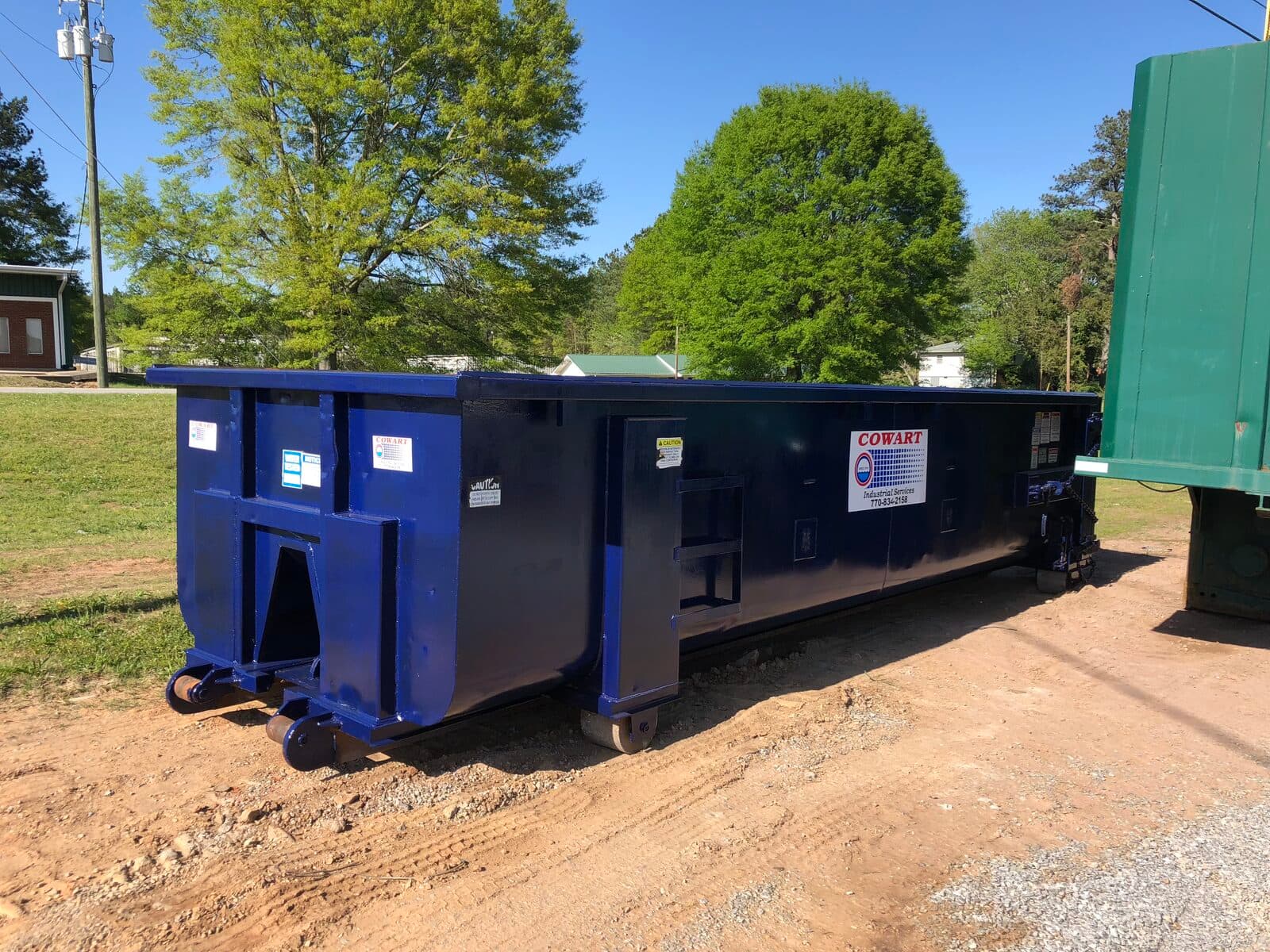
Solid waste runs a parallel path, roll-off containers and dump trailers transport to landfill or recovery facilities matched to the material. Same DOT number on the trucks, same documentation discipline, different end point.
Compliance documentation that comes with the disposal
Every disposal job produces a documentation packet: signed manifest (generator copy, transporter copy, disposal facility copy), scale ticket from the weigh-in, sampling records when applicable, treatment record from the plant, and certificate of disposition for the final fate of the material. For sites under permit (RCRA generator, industrial pretreatment, NPDES), documentation cadence and format are matched to permit requirements.
This matters because the disposal step is the part most generators get audited on. EPA and state environmental agencies want to see the paper trail from the waste leaving your facility to its final fate. Cowart's single-DOT, in-house-treatment model produces that paper trail under one company's name, so your contractor file has one tab and your auditor doesn't chase phantom subcontractors.
Industries we serve
Where we work
- Atlanta
- Augusta
- Columbus
- Macon
- Savannah
- Carrollton
- LaGrange
- Newnan
- Rome
- Birmingham
- Mobile
- Montgomery
- Huntsville
- Tuscaloosa
- Anniston
- Knoxville
- Chattanooga
- Nashville
- Memphis
- Columbia
- Charleston
- Greenville
- Spartanburg
- Charlotte
- Raleigh
- Greensboro
- Wilmington
- Jacksonville
- Tampa
- Pensacola
- Panama City
- Jackson
- Meridian
- Pascagoula
- Gulfport
- Louisville
- Lexington
- Owensboro
- Paducah
Common questions
Quick answers on scope, method, safety, and turnaround. Don’t see your question? Ask us directly.
Q-01What kinds of industrial waste do you dispose of?
Non-hazardous liquid and solid industrial waste, wastewater, oily water, sludge, sump and pit contents, parts-washer fluids, food-process waste (FOG, high-BOD), latex and paint-line wash, contaminated stormwater, water-based cleaning residuals, dewatered cake, contaminated soil, and demolition debris. Solid streams go to permitted landfill or recovery; liquid streams are treated at our own plant in Carrollton.
Q-02Do you dispose of hazardous waste?
No. Cowart's treatment plant and operations are permitted for non-hazardous streams only. RCRA-hazardous, characteristic-hazardous (corrosive, ignitable, reactive, toxic above thresholds), PCB-containing material, and radioactive material aren't accepted. If your facility generates hazardous waste, we can refer you to a permitted hazmat disposal contractor under a documented handoff.
Q-03How do I get a waste profile?
Call dispatch or use the contact form to start a profile. For most streams we ask for a representative sample and a description of how the waste is generated; we run the lab work and return a profile sheet within a few business days. The profile names the acceptance status, the disposal rate, and any handling notes. Profiles are good for a year and re-sampled annually for routine generators.
Q-04What documentation do I get with each disposal?
Signed manifest (generator, transporter, and disposal facility copies), scale ticket from the weigh-in, sampling records, treatment record from the plant, and certificate of disposition for the final fate of the material. For sites under permit (RCRA generator, NPDES, industrial pretreatment), documentation cadence and format are matched to what your permit requires.
Q-05Do you do scheduled pickup, or just one-off?
Both. Most generators run on weekly, biweekly, or monthly standing pickup schedules, same driver, same procedure, same dispatch contact each visit. One-off pickups handle project waste, turnaround volume, and unscheduled cleanouts. Emergency dispatch is available 24 hours from Carrollton for spills, containment failures, and process upsets.
Q-06What does waste disposal cost?
Cost depends on the waste profile, volume, transport distance, and treatment complexity. We quote in $/gallon for liquid streams and in $/ton or $/load for solids, with the rate set when the profile is approved. We own the treatment side, so the rate quoted is the rate charged, no pass-through markup from a third-party disposal facility, no surprise tipping fees.
Q-07What states do you serve for waste disposal?
Georgia, Alabama, Tennessee, South Carolina, North Carolina, Florida, Mississippi, and Kentucky. Dispatch is from Carrollton, GA. For sites outside the 8-state footprint, contact us, depending on the volume and material, we may still be able to accept the work.