Liquid Vacuum Truck Service
Liquid vacuum truck service across the Southeast, wastewater, sludge, slurries, sumps, and pits pumped, transported, and disposed in-house.
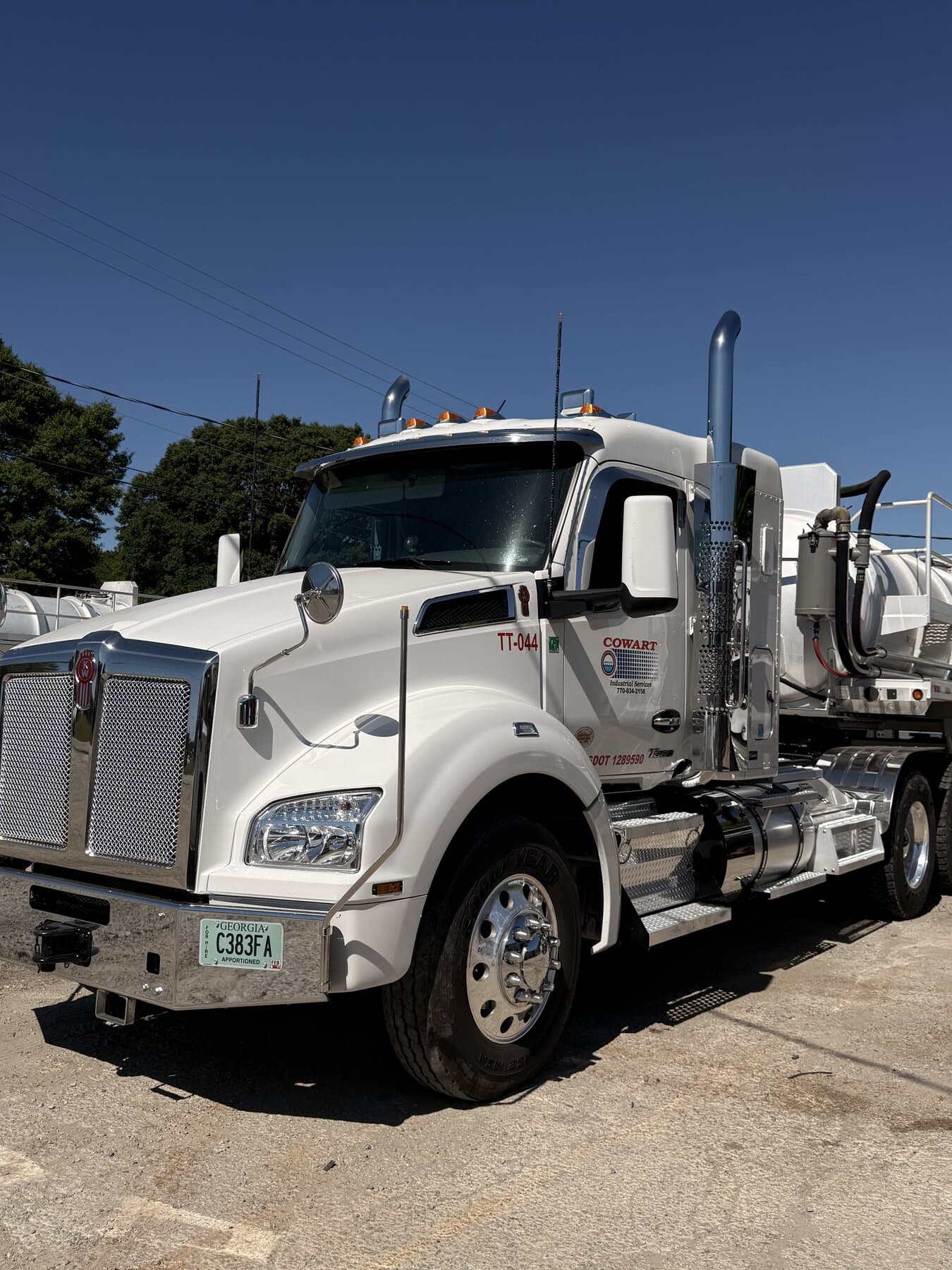
Cowart Industrial's liquid vacuum service uses dedicated vacuum tankers built for industrial liquid removal. The fleet runs 3,000 and 5,000 gallon configurations on Kenworth chassis, enough capacity to clear most industrial sumps or holding tanks in a single dispatch. Trucks are equipped with positive-displacement blowers, integrated steel tanks, and standard fittings that mate to vacuum hoses and on-site pumping connections.
The trucks handle wastewater, sludge, slurries, process water, oily water and emulsions, parts-washer fluids, sump and pit contents, food-process wastewater, and most non-hazardous industrial liquid waste streams. The work runs on standing scheduled pickups for facilities with recurring volume and 24-hour emergency response for tank overflows, line breaks, and containment events. Crews are HAZWOPER-40 and OSHA-30 certified, and confined-space credentials are standard, pit and sump cleanouts often require entry.
Liquid vacuum service runs end-to-end at Cowart: pump, transport, and dispose at our own non-hazardous wastewater treatment plant in Carrollton, Georgia. No broker handoffs. The driver who pumps the load is operating under the same DOT number as the company that owns the treatment plant, chain of custody stays intact from your site to the disposal facility, with one Certificate of Insurance on your audit file and one phone number to call if anything needs attention.
What liquid vacuum trucks actually do
An industrial liquid vacuum truck is a tank-on-a-chassis with a positive-displacement blower that pulls a partial vacuum on the tank interior. Drop a hose into a sump, holding tank, or pit and the blower lifts the liquid into the tank, no on-site pump required, no priming, no fuss with suction lift limits the way a centrifugal pump would have. The truck takes the load with it and delivers to a treatment or disposal point.
The 3,000 and 5,000 gallon configurations Cowart runs are sized for industrial work: enough capacity to clear a normal sump in one drop, small enough to navigate the access constraints of operating plants. A 5,000-gallon truck handles a typical industrial sump or holding tank pumpout in one cycle; multiple loads run back-to-back when the volume requires.
What we pump, and what we don't
We pump non-hazardous industrial liquids: wastewater (process, rinse, cooling), oily water and emulsions, parts-washer fluids, sludge that pumps as a liquid, slurries with manageable solids content, sump and pit contents, food-process wastewater (including high-BOD and FOG streams), latex and paint-line wash, contaminated stormwater, and water-based cleaning residuals. Liquid profile is verified before pickup, out-of-profile material is rejected at the source, not delivered to the plant and refused there.
We don't pump RCRA hazardous waste, characteristic-hazardous streams above thresholds, PCB-containing material, or anything our treatment plant isn't permitted to accept. If your material classifies as hazardous, we can refer you to a permitted hazmat responder under a documented handoff, but the liquid vacuum service itself is non-hazardous only.
Industries we serve
Where we work
- Atlanta
- Augusta
- Columbus
- Macon
- Savannah
- Carrollton
- LaGrange
- Newnan
- Rome
- Birmingham
- Mobile
- Montgomery
- Huntsville
- Tuscaloosa
- Anniston
- Knoxville
- Chattanooga
- Nashville
- Memphis
- Columbia
- Charleston
- Greenville
- Spartanburg
- Charlotte
- Raleigh
- Greensboro
- Wilmington
- Jacksonville
- Tampa
- Pensacola
- Panama City
- Jackson
- Meridian
- Pascagoula
- Gulfport
- Louisville
- Lexington
- Owensboro
- Paducah
Common questions
Quick answers on scope, method, safety, and turnaround. Don’t see your question? Ask us directly.
Q-01What is a liquid vacuum truck used for?
An industrial liquid vacuum truck pumps non-hazardous liquids out of tanks, sumps, pits, trenches, and containment basins, transports them under DOT regulation, and delivers them to a treatment or disposal facility. Common loads include process wastewater, oily water, sludge, parts-washer fluids, food-process waste, contaminated stormwater, and water-based cleaning residuals from industrial cleaning jobs.
Q-02How big are your vacuum tankers?
Cowart's standard liquid vacuum tankers are 3,000 and 5,000 gallons on Kenworth chassis. A 5,000-gallon truck handles a typical industrial sump or holding tank pumpout in a single load; larger jobs run back-to-back loads or use vacuum boxes as on-site staging.
Q-03Can you do emergency liquid vacuum response?
Yes. 24-hour dispatch from Carrollton, GA, with trucks staged for spill events, tank overflows, line breaks, and containment failures. Same-day response is typical across Georgia, Alabama, and the eastern half of our 8-state Southeast service area.
Q-04What happens to the liquid after pickup?
Recovered liquid travels under Cowart's own DOT number directly to our non-hazardous wastewater treatment plant in Carrollton, Georgia. We don't subcontract the transport or hand the load to a third-party disposal vendor, treatment and disposal stay under one company, one set of manifests, one Certificate of Insurance.
Q-05Do you handle hazardous liquids?
No. The liquid vacuum service and our treatment plant are non-hazardous only. Drivers are DOT Hazmat trained because some non-hazardous materials require hazmat transport precautions, but RCRA hazardous waste isn't accepted. We can refer you to a permitted hazmat responder if your material classifies as hazardous.
Q-06What states do you cover for liquid vacuum service?
Georgia, Alabama, Tennessee, South Carolina, North Carolina, Florida, Mississippi, and Kentucky. Dispatch is based in Carrollton, GA, with 24-hour coverage for both scheduled and emergency liquid vacuum work across the full 8-state footprint.