Industrial Waste Transport
DOT-certified industrial waste transport across 8 Southeastern states, vacuum tankers, dump trailers, roll-off trucks, no broker handoffs.
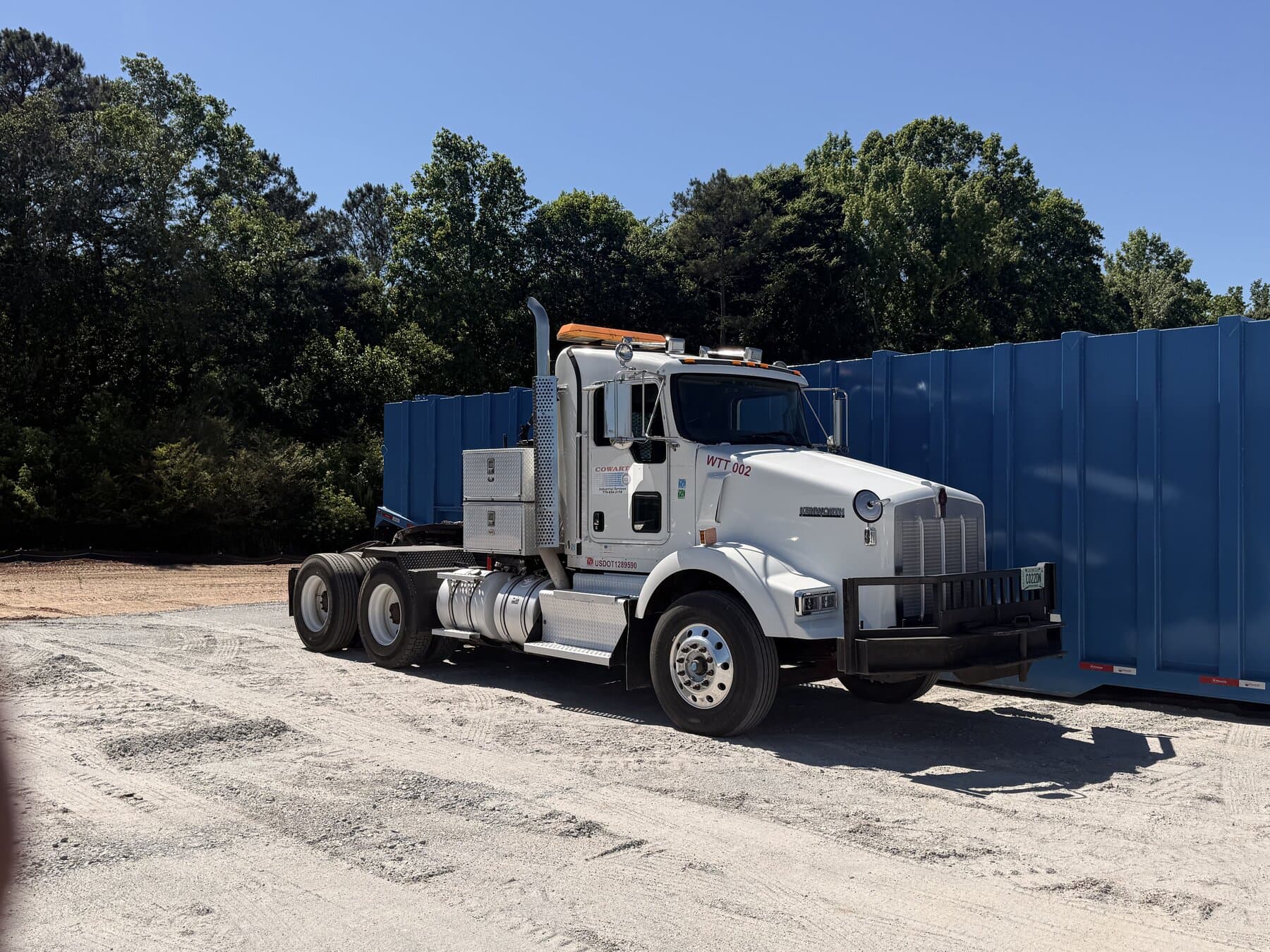
Cowart Industrial provides DOT-certified industrial waste transport for non-hazardous waste streams across the Southeastern United States. The fleet covers liquid vacuum tankers (3,000-5,000 gallon), sealed vacuum boxes, dump trailers for bulk solids, and roll-off trucks for containerized waste. Drivers are credentialed for the materials they haul, and every truck operates under Cowart's own DOT number, chain of custody never breaks across a subcontractor or a broker.
Waste transport covers the full range of non-hazardous industrial streams: process water and wastewater, sumps and pit contents, oily water and emulsions, parts-washer fluids, food-process waste, sludge and slurries (when contained in sealed vacuum boxes), and solid waste in roll-off containers or dump trailers. We handle scheduled standing routes for facilities with recurring volume, one-call dispatch for project work and plant turnarounds, and 24-hour emergency mobilization. Every load travels with a manifest, weight ticket, and the chain-of-custody documentation your generator file needs.
Our 8-state footprint covers Georgia, Alabama, Tennessee, South Carolina, North Carolina, Florida, Mississippi, and Kentucky. Drivers carry HAZWOPER-40, OSHA-30, DOT Hazmat, and EPA RCRA awareness credentials, some non-hazardous materials still require hazmat transport rules, and we run that way as default to avoid surprises. The compliance team can produce records for any load on request, with a turnaround measured in hours, not days. If you need waste off-site today, dispatch from Carrollton can usually have a truck on the road within hours.
Why our own DOT number matters
Most industrial waste transport happens through a chain of vendors: the generator hires a hauler, the hauler may subcontract to an actual trucking company, the trucking company drops the load at a transfer station, and a different hauler takes it to the disposal facility. Each step has its own DOT number, its own insurance certificate, and its own paperwork. When something goes wrong on the road, a spill, an accident, a manifest mismatch, figuring out who was in custody at the moment of the incident becomes a forensic exercise.
Cowart operates under its own DOT number on every truck that leaves your facility. The driver is a Cowart employee. The trailer is on Cowart's authority. The destination, our treatment plant in Carrollton, GA, or a permitted partner facility, is reached without a subcontracted leg in between. Your generator file shows one transporter, one Certificate of Insurance, one phone number when something needs attention.
What our fleet hauls
Liquid vacuum tankers are the workhorses, 3,000 and 5,000 gallon Kenworth tankers configured for industrial pickup. They handle wastewater, oily water, sludge that pumps as a liquid, sump and pit contents, process water, parts-washer fluids, food-process wastewater. The truck's positive-displacement blower pulls the load through the hose; no on-site pump is required.
For sludge and semi-solid material that won't pump as a liquid, we use sealed vacuum boxes, 20-yard steel containers rated for vacuum loading and DOT-regulated liquid transport. The boxes are staged on site, vacuumed full, sealed, and hauled out as a single contained load.
Dry-bulk solids (dewatered cake, contaminated soil, ash, refractory debris, demolition material) move in dump trailers, end-dump or live-bottom configurations for the volume and material type. Containerized waste (general industrial debris, dewatered sludge boxes) moves on roll-off trucks. Each configuration carries its own DOT manifest pattern, and we run all of them under one fleet operator so the dispatch is one phone call.
Scheduled, on-demand, emergency, all three run on the same paperwork
Most of our transport work runs on standing pickup schedules: weekly, biweekly, or monthly cycles for plants that generate predictable volume. The driver is consistent visit-to-visit, gate codes, weight ticket procedures, signoff routines stay the same, and dispatch knows the site. On-demand pickups handle one-off needs: project waste, turnaround volume, tank cleanouts that don't fit the standing cycle.
Emergency dispatch is 24-hour. Spill response, containment overflow, equipment failure that leaves a facility holding waste it can't process, call dispatch from Carrollton and tell them what's holding the waste. Same-day mobilization is typical across Georgia, Alabama, and the eastern half of our service area; the full 8-state footprint is reached on appropriately scaled response windows. The paperwork on a 2 AM spill call matches the paperwork on a Tuesday-morning scheduled pickup, manifest, weight ticket, sampling if applicable, disposition certificate when the load is treated or landfilled.
Industries we serve
Where we work
- Atlanta
- Augusta
- Columbus
- Macon
- Savannah
- Carrollton
- LaGrange
- Newnan
- Rome
- Birmingham
- Mobile
- Montgomery
- Huntsville
- Tuscaloosa
- Anniston
- Knoxville
- Chattanooga
- Nashville
- Memphis
- Columbia
- Charleston
- Greenville
- Spartanburg
- Charlotte
- Raleigh
- Greensboro
- Wilmington
- Jacksonville
- Tampa
- Pensacola
- Panama City
- Jackson
- Meridian
- Pascagoula
- Gulfport
- Louisville
- Lexington
- Owensboro
- Paducah
Common questions
Quick answers on scope, method, safety, and turnaround. Don’t see your question? Ask us directly.
Q-01What is industrial waste transport?
Industrial waste transport is the DOT-regulated movement of non-hazardous waste streams from the generating facility to a treatment or disposal site. It includes the truck, driver, manifest, and chain-of-custody documentation that tracks the load from pickup to final disposition. The transport step is regulated under DOT hazmat rules (even for many non-hazardous materials) and is part of the generator's compliance paper trail.
Q-02What trucks do you operate?
3,000 and 5,000 gallon liquid vacuum tankers on Kenworth chassis, sealed 20-yard vacuum boxes for sludge transport, dump trailers (end-dump and live-bottom) for dry bulk, and roll-off trucks for containerized waste. Every truck runs under Cowart's own DOT number, and drivers carry HAZWOPER-40, OSHA-30, DOT Hazmat, and EPA RCRA awareness credentials.
Q-03Do you operate under your own DOT number?
Yes. Every truck that leaves your facility is a Cowart truck operated by a Cowart driver under Cowart's DOT authority. We don't subcontract transport to brokers or third-party haulers. The chain of custody is unbroken from pickup at your site to delivery at our treatment plant in Carrollton, GA or to a permitted partner facility.
Q-04Can you handle scheduled pickups and emergency response?
Both. Most generators run on weekly, biweekly, or monthly standing schedules with the same driver each visit. 24-hour emergency dispatch from Carrollton covers spill response, containment overflow, tank failure, and any unplanned event that puts a facility on the clock to move waste off site.
Q-05What documentation comes with each transport?
Signed manifest (generator, transporter, and disposal facility copies), weight ticket from the weigh-in, BOL where applicable, sampling records when required, and certificate of disposition tying the load to its final treatment or disposal. Documentation is in your hands within standard turnaround, same week for routine, same day for urgent.
Q-06Do you transport hazardous waste?
No. The fleet is set up for non-hazardous waste transport only. RCRA hazardous, characteristic-hazardous (corrosive, ignitable, reactive, toxic above thresholds), and PCB-containing material aren't accepted. Drivers are DOT Hazmat-trained because some non-hazardous materials require hazmat transport precautions, but the disposal end of the operation is non-hazardous.
Q-07What states do you transport in?
Georgia, Alabama, Tennessee, South Carolina, North Carolina, Florida, Mississippi, and Kentucky. The treatment plant is in Carrollton, GA, and routes radiate from there. For sites outside the 8-state footprint, contact us, depending on the volume and material, we may still be able to handle the work.