
Industrial Dump Trailer Service
End-dump trailers for bulk industrial material: contaminated soil, dewatered sludge, ash, demo debris. Georgia-based crews hauling across the Southeast.
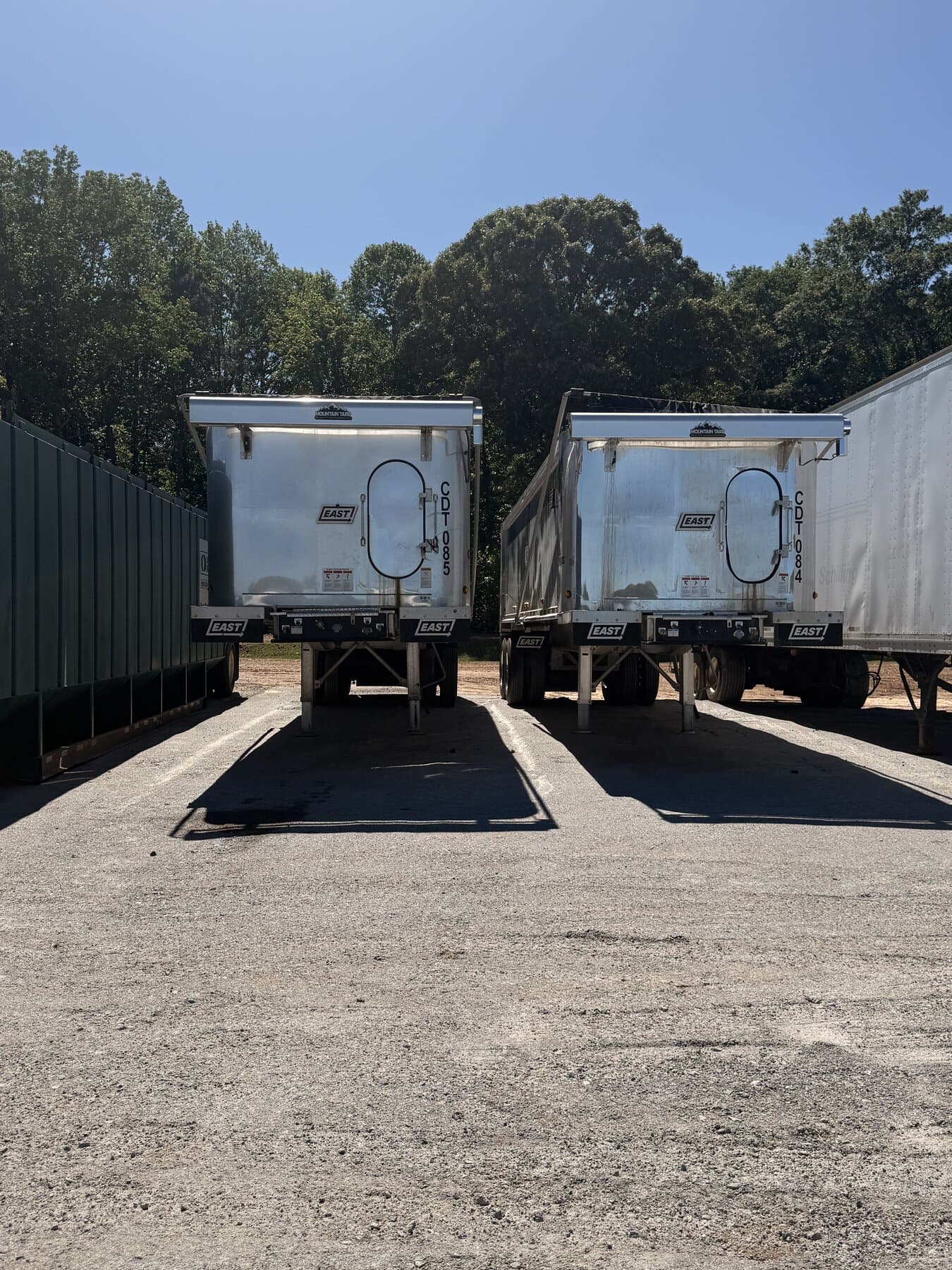
Cowart Industrial provides dump trailer service for industrial sites moving high volumes of loose bulk material across the Southeastern United States. Our end-dump trailers carry significantly more per load than a roll-off box and discharge by raising the front and tipping the load out the rear, efficient for material that flows on tip-out: contaminated soil, dewatered sludge cake, industrial ash, sand, aggregates, grit, refractory removal debris, and demolition material. Live-bottom configurations are also available for materials that don't tip cleanly.
Dump trailers are the right call when the volume is too large for roll-off boxes and the material is too solid for a vacuum tanker. We load on site, by excavator, loader, conveyor, or directly from a dewatering operation, and haul the material to our own non-hazardous treatment plant in Carrollton or to a permitted disposal facility matched to the material profile. Multiple trailers can run in rotation to keep a loading operation moving without downtime, common during plant turnarounds and large remediation projects.
Every load travels under Cowart's own DOT number with the manifests, scale tickets, and certificates of disposition your environmental department expects. Drivers carry HAZWOPER-40, OSHA-30, DOT Hazmat, and EPA RCRA awareness credentials. Scheduled hauling for ongoing projects and one-call dispatch for turnarounds, cleanouts, and emergency mobilization all run under the same paperwork standards across our 8-state Southeastern footprint: GA, AL, TN, SC, NC, FL, MS, KY.
When dump trailer is the right choice
Three vehicle classes handle bulk material movement on industrial sites: vacuum tankers (free-flowing liquids), sealed vacuum boxes (sludge and semi-solids), and dump trailers (dry bulk solids). The right call depends on the material's consistency, volume, and how it gets loaded. If you can move it with a loader or excavator and it tips out cleanly when the trailer raises, you want a dump trailer. If it pumps as a liquid, you want a tanker. If it's somewhere in between, you want a sealed vacuum box.
Dump trailers shine on three job types: contaminated soil removal (remediation projects, tank pulls, underground storage tank cleanups), dewatered sludge transport (when a wastewater plant or industrial dewatering operation produces filter cake that ships dry), and post-demolition cleanup (refractory removal, debris from equipment teardown, ash and bottom solids from boilers). The economics favor dump trailers for any sustained, high-volume job, they carry significantly more per load than a 40-yard roll-off, and the loading/tipping cycle is faster.
End-dump vs. live-bottom
Our standard configuration is end-dump, the trailer raises from the front and the load discharges out the back. It works well for free-flowing material (soil, ash, sand, aggregates, broken refractory). What it doesn't handle well is sticky material, wet clay, oily soil, partially-dewatered sludge that bridges in the trailer instead of flowing out.
For those materials, live-bottom trailers move the load with an internal conveyor belt while the trailer stays flat. The material walks out the back continuously instead of being dumped at once. Live-bottom is available on request when the material profile warrants it; standard end-dump handles the vast majority of jobs.
Single-DOT, single-vendor on bulk moves
Same model as the rest of Cowart's operation: every dump trailer that leaves your facility is a Cowart trailer pulled by a Cowart tractor with a Cowart driver, operating under Cowart's DOT authority. We don't subcontract bulk transport to brokers or owner-operators. The chain of custody on the load is unbroken from the loader's bucket to the disposal facility's tipping floor.
That matters for environmental compliance: when EPA or a state agency wants to know who was in custody of the contaminated soil between the remediation site and the landfill, the answer is one company, on one Certificate of Insurance, with one set of records. For large remediation projects with regulatory oversight, that simplicity is the actual product.
Industries we serve
Where we work
- Atlanta
- Augusta
- Columbus
- Macon
- Savannah
- Carrollton
- LaGrange
- Newnan
- Rome
- Birmingham
- Mobile
- Montgomery
- Huntsville
- Tuscaloosa
- Anniston
- Knoxville
- Chattanooga
- Nashville
- Memphis
- Columbia
- Charleston
- Greenville
- Spartanburg
- Charlotte
- Raleigh
- Greensboro
- Wilmington
- Jacksonville
- Tampa
- Pensacola
- Panama City
- Jackson
- Meridian
- Pascagoula
- Gulfport
- Louisville
- Lexington
- Owensboro
- Paducah
Common questions
Quick answers on scope, method, safety, and turnaround. Don’t see your question? Ask us directly.
Q-01What is an end-dump trailer used for?
End-dump trailers haul loose bulk solid material in industrial volumes, contaminated soil, dewatered sludge cake, industrial ash, sand, aggregates, refractory debris, and demolition material. The trailer raises from the front and tips the load out the rear, which is efficient for material that flows freely on discharge.
Q-02How does a dump trailer differ from a roll-off?
Roll-off containers are stationary boxes you load on site, then a roll-off truck hauls them away as a unit. Dump trailers are towed behind a tractor and load while connected, so the same trailer can run multiple loads per day on a sustained operation. Dump trailers carry significantly more per load and are usually the right choice when you need to move a large bulk volume in a compressed window.
Q-03What materials can you haul in dump trailers?
Non-hazardous bulk solids, contaminated soil characterized for landfill acceptance, dewatered sludge cake, industrial ash (fly ash, bottom ash, ESP hopper material), sand, aggregates, grit, refractory removal debris, and demolition material that's been size-reduced for the trailer. Wet, sticky, or partially-liquid materials need a sealed vacuum box instead.
Q-04Do you offer live-bottom trailers?
Yes, on request. Live-bottom trailers use an internal conveyor to walk the load out the back while the trailer stays flat, useful for sticky materials that don't tip out cleanly (wet clay, oily soil, partially-dewatered sludge). Standard end-dump handles the vast majority of jobs; live-bottom is matched to the material when the profile warrants it.
Q-05Do you handle hazardous material in dump trailers?
No. The fleet is set up for non-hazardous bulk hauling only. RCRA-hazardous waste, characteristic-hazardous material, PCB-containing material, and radioactive material aren't accepted. Some non-hazardous contaminated soils require hazmat-style transport precautions; drivers are DOT Hazmat-trained to handle those cases.
Q-06Can you run multiple trailers for a high-throughput project?
Yes. Multi-trailer rotation is common for remediation projects, plant turnarounds, and sustained dewatering operations. We coordinate trailer pulls and tractor rotation to keep the loading operation moving without bottlenecks, typically 3-6 trailers in continuous rotation for medium-large projects.
Q-07What states do you serve for dump trailer work?
Georgia, Alabama, Tennessee, South Carolina, North Carolina, Florida, Mississippi, and Kentucky. Dispatch is from Carrollton, GA. For large multi-trailer projects, we can stage equipment near the job site for the project duration.